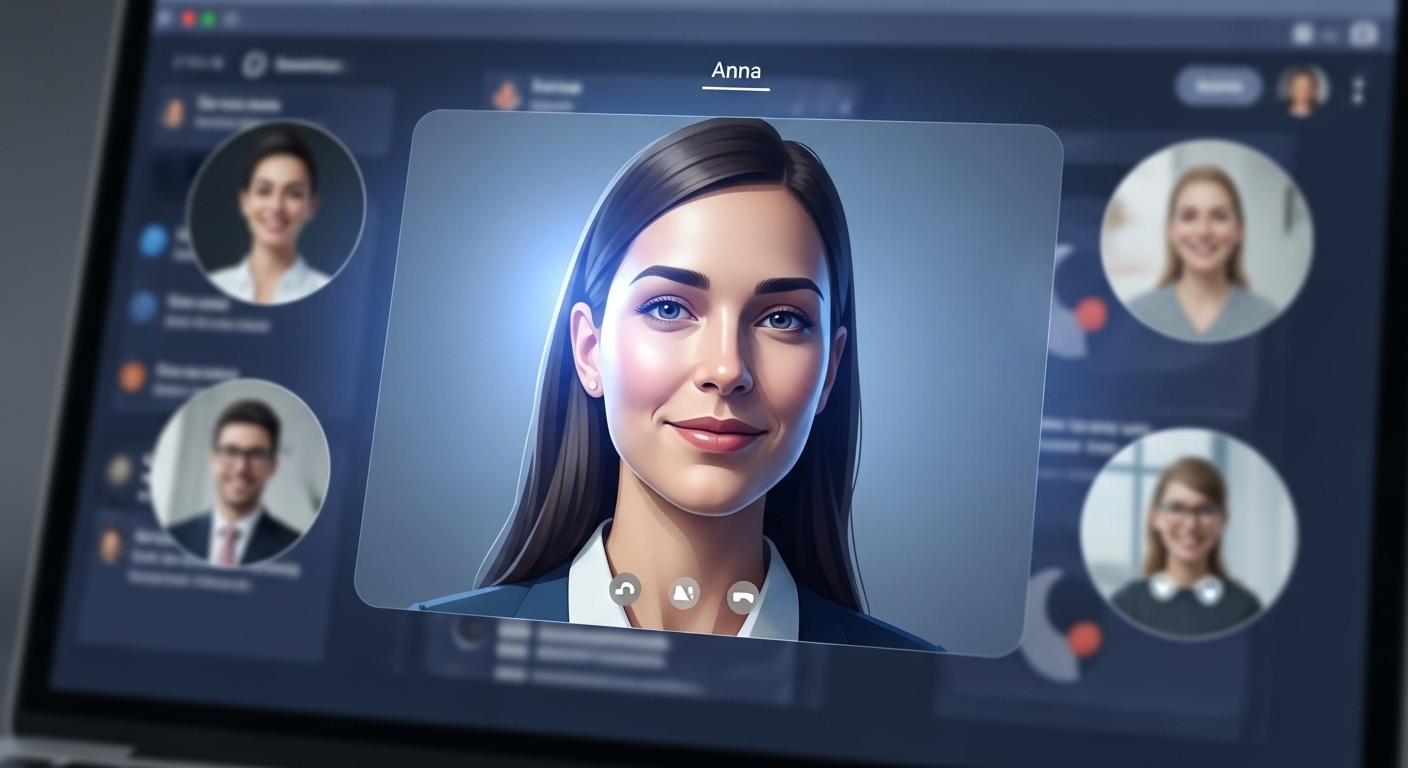
In the TOEIC test, meeting conversations often appear in both the Listening and Speaking sections — especially self-introductions and meeting openers.
Many learners freeze during these moments and lose easy points. The truth is, mastering just a few high-frequency sentence patterns can help you score higher and sound more professional in real business settings.
Today, you’ll learn one simple line that helps you stand out and win the room.
🎧Apple Podcast|Spotify
💬 Dialogue|TOEIC Meeting Simulation
Scenario:
A weekly online meeting at an international company. A new employee is asked to introduce herself.
English Conversation
John (Manager): Good morning, everyone. Before we start, let’s welcome our new colleague.
Anna (New Staff): Thank you. Hello, my name is Anna Chen. I recently joined the marketing department.
John: Could you give us a quick self-introduction?
Anna: Sure. I have over five years of experience in digital marketing, especially in social media campaigns.
Lisa (Colleague): That’s impressive! Social media has become essential for brand promotion.
Anna: Exactly. I look forward to contributing fresh ideas to our upcoming projects.
John: Great. Our team is currently working on a campaign related to the Paris Olympics.
Anna: Oh, that’s exciting! I actually worked on a sports-related campaign last year.
Lisa: Perfect timing, then. Your expertise will be valuable.
John: Alright, let’s move on to today’s agenda.
📚 Vocabulary Boost|TOEIC High-Frequency Words
| Word | Part of Speech | Meaning | Example Sentence |
|---|---|---|---|
| agenda | n. | meeting schedule | The manager shared today’s agenda before the meeting started. |
| colleague | n. | coworker | I discussed the project with my colleague from the finance team. |
| contribute | v. | to add or provide | She hopes to contribute new ideas to the campaign. |
| department | n. | division or section | He was transferred to the sales department last month. |
| expertise | n. | specialized knowledge | Her expertise in social media will benefit the project. |
| campaign | n. | project or initiative | The marketing team launched a new advertising campaign. |
| upcoming | adj. | approaching or soon | We are preparing for the upcoming product launch. |
| impressive | adj. | remarkable | His TOEIC score of 950 was truly impressive. |
| essential | adj. | necessary | Good communication skills are essential for leadership. |
| promote | v. | to advertise or push forward | The company plans to promote its services in Asia. |
🔍 Grammar Focus|Common TOEIC Structures
| Structure | Meaning | Example |
|---|---|---|
| be responsible for + N/V-ing | to be in charge of | She is responsible for managing the project budget. |
| look forward to + N/V-ing | to expect eagerly | I look forward to working with all of you. |
| be involved in + N | to take part in | He was involved in the product launch. |
| due to + N | because of | The meeting was delayed due to heavy traffic. |
| as soon as + S + V | immediately after | Please call me as soon as you arrive. |
| be assigned to + N | to be designated for | She was assigned to the new marketing project. |
📖 Transcript
A: Welcome to Win in 5 Minutes English.
B: Win in 5.
B: Today, we’re focusing on making a great impression in professional meetings, especially when you need to introduce yourself.
A: We’re going to look at a typical online meeting scenario and break down the language used so you can use these techniques yourself.
B: So, let’s just jump straight into the conversation. Imagine an international company’s weekly online meeting, a new employee, Anna, is asked to introduce herself. Let’s listen.
A: Good morning, everyone. Before we start, let’s welcome our new colleague.
B: Thank you. Hello, my name is Anna Chen. I recently joined the marketing department.
A: Could you give us a quick self-introduction?
B: Sure. I have over five years of experience in digital marketing, especially in social media campaigns.
A: That’s impressive. Social media has become essential for brand promotion.
B: I look forward to contributing fresh ideas to our upcoming projects.
A: Great. Our team is currently working on a campaign related to the Paris Olympics.
B: Oh, that’s exciting! I actually worked on a sports-related campaign last year.
A: Perfect timing, then. Your expertise will be valuable.
A: All right, let’s move on to today’s agenda.
A: Okay, so that was the exchange. Pretty standard stuff on the surface, but let’s unpack it.
B: What makes Anna’s introduction work so well?
A: Well, first off, it’s efficient. “Hello, my name is Anna Chen. I recently joined the marketing department.” Straight away, you know who she is and where she fits, no waffle.
B: And then she adds her experience, “over five years in digital marketing.”
A: Especially social media campaigns. That’s quite specific.
B: It’s not just saying, “I have experience.” She immediately highlights relevant skills. Uh, you know, John’s prompt, “Could you give us a quick self-introduction?” is super common, and she uses it perfectly to give that key info.
A: Yeah, it’s targeted. She’s not listing everything she’s ever done.
B: And then, critically, she looks forward with the “I look forward to contributing fresh ideas,” Ryan. Why is that so important? Could it sound a bit, I don’t know, pushy?
A: That’s a fair point to consider, but I think the way she phrases it, “contributing fresh ideas to our upcoming projects,” links her enthusiasm directly to the team’s current work. It’s proactive, not pushy.
B: Oh, okay. So it shows she wants to be part of the team effort, not just talk about herself.
A: Precisely. And linking it to the Paris Olympics campaign, like John does, makes it even more concrete. It shows she’s already thinking about their goals.
B: And Lisa’s reaction confirms it worked.
A: Right. The, “That’s impressive,” and “your expertise will be valuable.” That’s immediate positive feedback. It shows Anna hit the right notes.
B: It integrates her straight away.
A: Okay, moving beyond the flow, let’s zoom in on some specific vocabulary used here. Words that really add professional weight.
B: We heard expertise, contribute, campaign, upcoming, and essential. How did these specific words give Anna an edge?
A: Take expertise. It’s much stronger than just saying, you know, “what I’m good at, my skills.” It implies a deeper, more specialized knowledge. It frames your value differently.
B: Like you’re bringing something specific and high-level to the table.
A: And contribute. It’s active. It suggests you’re there to add value, to make things happen, not just occupy a seat. It signals proactive engagement.
B: And campaign, upcoming, essential? Those are just standard professional terms. Using them shows you speak the language of business. Campaign for a specific project, upcoming for future events or deadlines. It adds precision.
A: Makes sense. And essential?
B: That adds weight. When Lisa says, “Social media is essential,” it underlines its importance. Using words like these correctly makes your communication sound, well, more polished and credible.
A: Okay, so vocab’s key. But what about the grammar, the sentence structures? We noticed a couple of patterns. “Look forward to plus a noun or the ING form of a verb.”
B: Right, like Anna saying, “looking forward to contributing.” Or you might say, “look forward to the meeting.”
A: And the other one was “be responsible for,” also followed by a noun or ING verb. Like “responsible for managing the project” or “responsible for the report.” How did these help your professional English?
B: They’re incredibly useful for clarity and building connection. “Look forward to” shows enthusiasm and positive anticipation. It’s great for emails, closing conversations. It builds rapport. “I look forward to working with you.” Simple, but effective.
A: Conveys almost commitment.
B: Yeah, a shared future focus.
A: And “be responsible for” is all about clarity. It defines roles precisely. “He is responsible for client communication” leaves no doubt. Using these structures correctly just makes you sound more fluent and professional. It shows you understand how to communicate clearly and appropriately in a business context.
B: So, really, by looking closely at just this short meeting introduction, you can pick up quite a bit about sounding confident and professional yourself.
A: Absolutely. It often comes down to these small, strategic choices in language and structure, not necessarily complex vocabulary, but the right vocabulary and phrasing. It shows how even simple phrases, used thoughtfully, can really shape how you’re perceived and, you know, maybe even open doors.
B: Want the full transcript, key vocabulary, and useful sentence patterns from today? Just click the link below. Thanks for tuning in to Win in 5 Minutes English. Keep practicing and make your professional English count.
✅ Quick Check Quiz
📌 Further Reading
【Office Daily English】 — How to Use “We Need the Final Numbers by Friday” Naturally
【Travel English】How to Plan a Business Trip & Manage Reservations

Comments