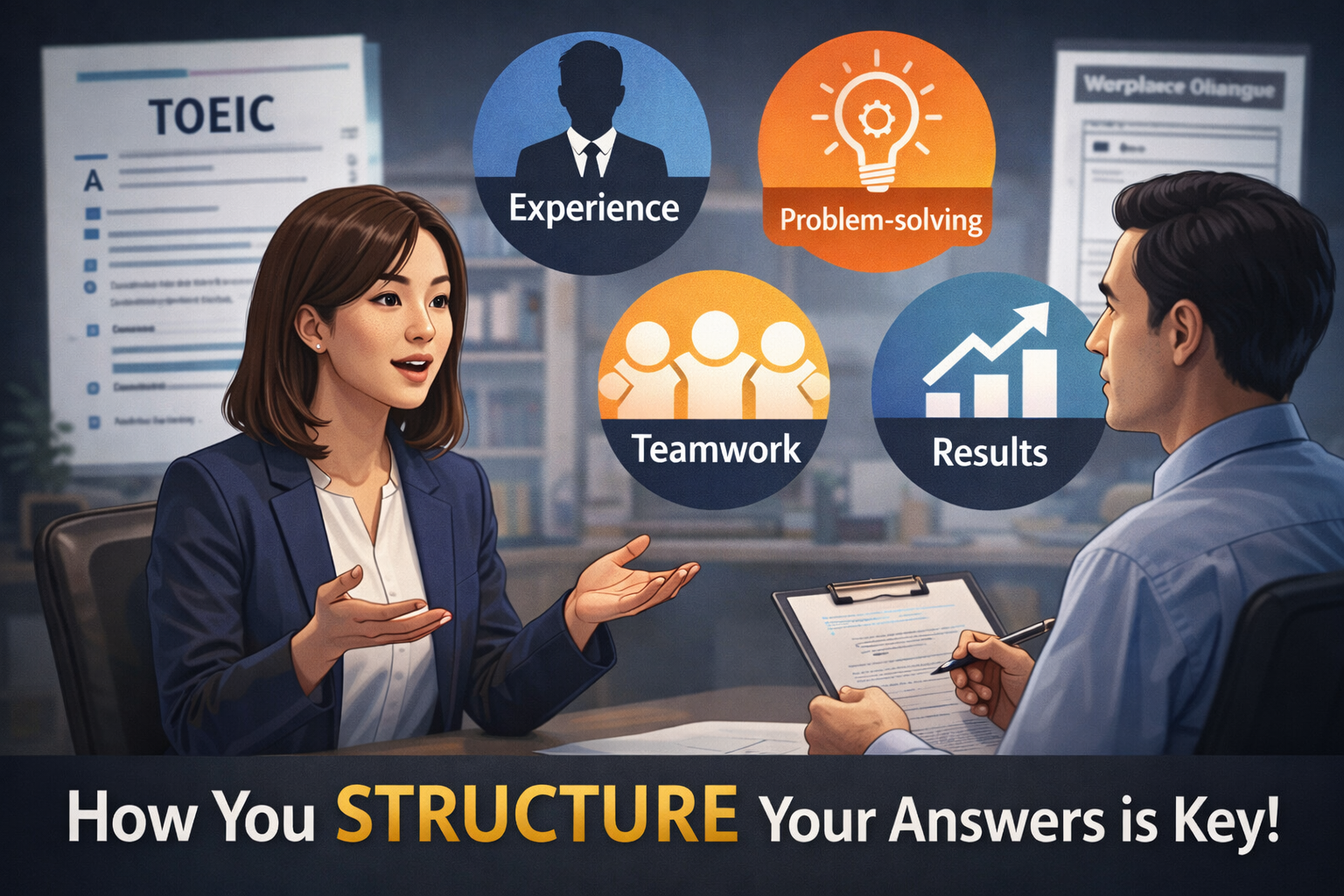
Many job candidates focus on grammar accuracy and vocabulary size when preparing for interviews.
However, in both TOEIC exams and real-world interviews, success depends far more on how you structure your answers than on how advanced your English sounds.
Expressions related to experience, problem-solving, teamwork, and results appear frequently on the TOEIC test — especially in listening and workplace dialogues.
🎧Apple Podcast|Spotify
💬 Dialogue Section
Scenario:
A remote job interview for an international company. The interviewer focuses on work experience and thinking process rather than language complexity.
Full English Dialogue
Interviewer (Emma): Could you tell me about a challenge you faced at work?
Candidate (Leo): Certainly. In my previous role, we faced tight deadlines due to a sudden change in project scope.
Emma: How did you handle the situation?
Leo: I prioritized tasks, communicated clearly with the team, and adjusted the timeline where possible.
Emma: What was the outcome?
Leo: As a result, we delivered the project on time and improved team efficiency.
Emma: What would you say is your biggest strength?
Leo: I’d say my ability to stay organized and remain calm under pressure.
Emma: How does that help in a team environment?
Leo: It allows me to support others and keep projects moving forward.
Emma: Thank you. That’s very clear.
Leo: Thank you for the opportunity.
📚 Vocabulary Boost — Key TOEIC Words
| Word / Phrase | Part of Speech | Meaning | Example Sentence |
|---|---|---|---|
| challenge | noun | difficulty or problem | We faced a major challenge during the project. |
| deadline | noun | time limit | The deadline was moved forward unexpectedly. |
| prioritize | verb | decide what is most important | Please prioritize urgent tasks first. |
| communicate | verb | share information clearly | We need to communicate clearly with stakeholders. |
| outcome | noun | result | The outcome exceeded expectations. |
| strength | noun | strong point | Organization is my greatest strength. |
| under pressure | phrase | in stressful situations | He performs well under pressure. |
| efficiency | noun | ability to work well | This process improved team efficiency. |
| support | verb | help | Team members support each other. |
| opportunity | noun | chance | Thank you for the opportunity to interview. |
🔍 Grammar Points — TOEIC-Relevant Patterns
| Structure / Pattern | Meaning | Example Sentence |
|---|---|---|
| In my previous role, ~ | talking about past work | In my previous role, I managed client accounts. |
| As a result, ~ | showing results | As a result, productivity increased. |
| I’d say ~ | giving opinions | I’d say teamwork is essential. |
| This allows me to ~ | explaining impact | This allows me to stay focused. |
| under pressure | describing conditions | She works well under pressure. |
📖 Transcript
M: Welcome to Win in 5 Minutes English. Today we’re going to tackle something huge. Job interviews.
J: Always a big topic.
M: Right. But we’re not just going to give you a list of fancy words to memorize. We’re focusing on structure.
M: Because, you know, you can have the best vocabulary, but if your answers wander, you’ve lost them.
J: That’s absolutely the truth.
J: It’s the same in a TOEIC speaking test or a real-life interview.
J: The people who win are the ones who can organize their thoughts clearly.
J: It’s not about sounding like a dictionary.
M: It’s about telling a clear story.
M: And we’ve got a perfect example.
M: We’re going to listen to a bit of an interview with a candidate named Leo.
J: He’s speaking with Emma, the interviewer.
M: Pay attention to how he structures his answers.
M: Moving from the problem to the solution.
M: Let’s just play it.
Scenario:
A remote job interview for an international company. The interviewer focuses on work experience and thinking process rather than language complexity.
Full English Dialogue
Interviewer (Emma): Could you tell me about a challenge you faced at work?
Candidate (Leo): Certainly. In my previous role, we faced tight deadlines due to a sudden change in project scope.
Emma: How did you handle the situation?
Leo: I prioritized tasks, communicated clearly with the team, and adjusted the timeline where possible.
Emma: What was the outcome?
Leo: As a result, we delivered the project on time and improved team efficiency.
Emma: What would you say is your biggest strength?
Leo: I’d say my ability to stay organized and remain calm under pressure.
Emma: How does that help in a team environment?
Leo: It allows me to support others and keep projects moving forward.
Emma: Thank you. That’s very clear.
Leo: Thank you for the opportunity.
M: Okay, so Leo sounded incredibly steady there.
M: The thing that stands out to me is he didn’t just list things.
M: He showed how he thinks.
M: Like when he used that word “prioritized”, to me, that’s not just about making a to-do list.
M: It signals that he can, you know, separate what’s important from what’s just loud.
J: “Prioritized” is such a power verb.
J: It tells a manager, “I don’t just react, I manage.”
J: It implies you can handle the chaos.
J: And that’s a leadership trait, even if you’re not a manager.
M: And then he used the word “efficiency”.
J: That felt so much stronger than just saying “we finished fast”.
M: It’s the difference between hard work and smart work, isn’t it?
M: Employers love that word.
M: It basically means you’re thinking about saving time and money.
J: And what about his strength? Staying calm under pressure.
M: Oh, that’s huge.
M: That’s one of those soft skills that’s actually really hard.
M: If you say you’re calm under pressure, you’re telling them you’re reliable when things go wrong.
M: Okay, so let’s break down the actual structure.
M: The architecture of his answers.
J: He used these little signposts.
M: He did. Like starting with “In my previous role”.
J: It seems so basic, but it immediately grounds the story in reality.
M: It’s not some hypothetical situation.
M: It anchors it, yes.
M: But for me, the real hero phrase was “As a result”.
J: That’s the pivot point.
M: It’s like he used it to force himself to stop talking about the process and start talking about the win.
J: That is exactly what it does.
J: So many people get lost in the details of the problem.
J: When you say “as a result”, you’re pointing your brain, and the interviewer’s brain, directly at the positive outcome.
J: You finish the story.
M: And he did the same thing for his strength.
M: Instead of just saying “I’m organized”, he connected it to the team with “This allows me to support others”.
J: It answers the “so what?” question before they can even ask.
J: It shows you’re thinking about your impact on everyone else.
J: You’re not just organized for yourself.
J: You’re organized to make the whole team better.
M: So I guess the big takeaway isn’t just about memorizing words like “efficiency”.
M: It’s about using these little structural phrases.
M: “As a result”, “This allows me to…” to guide the interviewer through your thought process.
J: And here’s a final thought on that.
J: Structure is a form of empathy.
J: When your answer is clear and structured, the interviewer doesn’t have to work so hard to understand you.
J: You make them feel smart.
J: And we tend to hire people who make us feel safe and understood.
M: That’s a great way to put it.
M: That’s it for today’s Win in 5 Minutes English.
M: Remember, 5 minutes a day is all you need to win at work, win the TOEIC, and win over your colleagues.
M: If you found this episode useful, don’t forget to follow and share it with your friends.
M: See you next time.


Comments