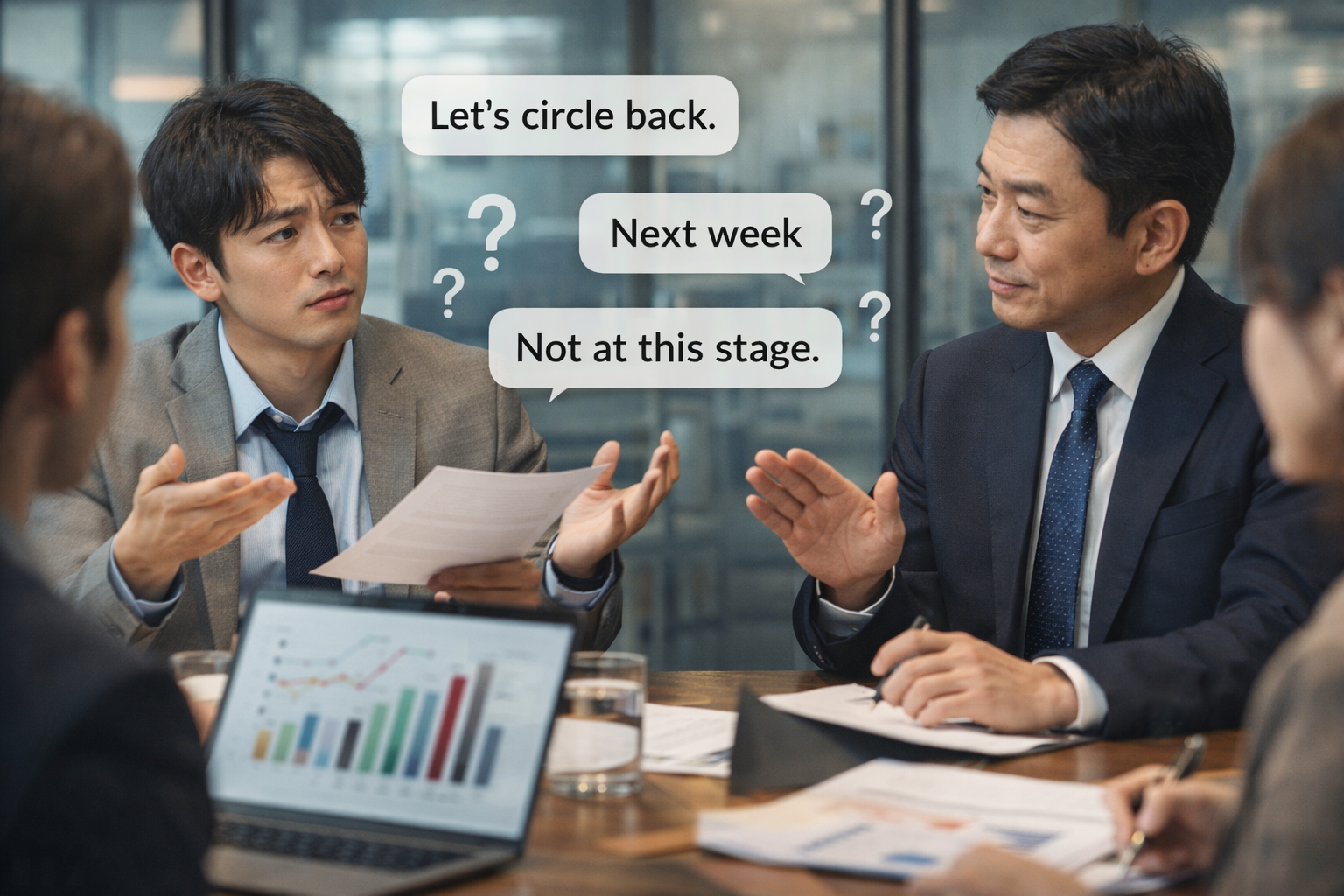
In multinational companies, managers rarely say “no” directly. Instead, they use phrases such as “Let’s circle back,” “Not at this stage,” or “We’ll revisit this next week.”
You will learn how to interpret corporate subtext, understand high-frequency TOEIC meeting expressions, and improve your listening accuracy for higher score performance.
🎧Apple Podcast|Spotify
Dialogue
Scenario: Corporate Strategy Meeting
Michael (Manager): Thanks for the update, Sarah.
Sarah (Analyst): Based on the data, I suggest increasing the marketing budget by 20%.
Michael: That’s an ambitious proposal.
Sarah: Do you think we should proceed next quarter?
Michael: Let’s circle back once we have more clarity on Q3 revenue.
Sarah: So we’re not approving it yet?
Michael: Not at this stage. We need to evaluate the risk.
Sarah: Understood. Would you like a revised forecast?
Michael: That would be helpful. Please include a more conservative estimate.
Sarah: I’ll prepare an updated report and get back to you by Thursday.
Michael: Perfect. Let’s revisit this next week.
What “Let’s Circle Back” Typically Implies
In corporate communication, “Let’s circle back” often implies:
- The decision is postponed
- The manager is not ready to approve
- Additional information is required
- The proposal may not be accepted
On the TOEIC exam, you may see questions such as:
- What does the manager imply?
- What will the speaker most likely do next?
- Why does the manager respond this way?
Understanding subtext is critical for high scores.
Vocabulary Boost — Key TOEIC Words
| Word / Phrase | IPA | Part of Speech | Meaning | Example Sentence |
|---|---|---|---|---|
| circle back | /ˈsɜːrkəl bæk/ | phrase | return to discuss later | Let’s circle back next week after Finance reviews the data. |
| proposal | /prəˈpoʊzəl/ | noun | formal business suggestion | The proposal requires further evaluation. |
| ambitious | /æmˈbɪʃəs/ | adjective | showing bold goals | That’s an ambitious target for Q4. |
| evaluate | /ɪˈvæljueɪt/ | verb | assess carefully | We need to evaluate the financial impact. |
| forecast | /ˈfɔːrkæst/ | noun | prediction based on data | The sales forecast needs adjustment. |
| conservative | /kənˈsɜːrvətɪv/ | adjective | cautious estimate | Provide a more conservative projection. |
| clarity | /ˈklærəti/ | noun | clear understanding | We need more clarity before making a decision. |
| revenue | /ˈrevənuː/ | noun | company income | Q3 revenue figures are not finalized. |
| approve | /əˈpruːv/ | verb | officially accept | The budget was not approved today. |
| revisit | /ˌriːˈvɪzɪt/ | verb | discuss again later | We will revisit this issue next week. |
Grammar Points
| Structure / Pattern | Meaning | Example Sentence | Typical TOEIC Use Case |
|---|---|---|---|
| once + clause | after something happens | Once we have clarity, we’ll decide. | Listening condition questions |
| Not at this stage | temporary refusal | Not at this stage. | Speaker intent questions |
| That would be helpful | polite request | That would be helpful. | Corporate tone analysis |
| get back to + person | respond later | I’ll get back to you by Thursday. | Email or meeting follow-up |
📖 Transcript
M: You know that feeling when you walk out of a meeting and you’re thinking, “Wow, that went great!”?
M: And then maybe an hour later, it hits you. You actually got completely shut down.
J: Absolutely. It’s the soft “no.” It’s an art form, really. It’s designed to make you feel heard…
M: …while simultaneously just killing your project.
J: And I think the masterpiece of that entire art form has to be the phrase “Let’s circle back.”
M: Oh, it’s a classic. It’s so dangerous because it sounds like a promise, you know? “We’ll talk later.”
J: Right. But what it really means is “I don’t want to talk about this now,” or more likely, “This is never happening.”
M: And that’s why we’re here. Welcome to Win in 5 Minutes English. We want to help you decode that corporate speak.
J: So you can actually win the meeting, not just survive it.
M: Today, we’re going to break down a strategy meeting. It’s between Michael, a manager, and Sarah, an analyst who wants more budget.
J: A very common scenario. Sarah’s asking for a 20% increase, and Michael… well, let’s just listen to how he handles it.
Dialogue (Scenario: Corporate Strategy Meeting)
Michael (Manager): Thanks for the update, Sarah.
Sarah (Analyst): Based on the data, I suggest increasing the marketing budget by 20%.
Michael: That’s an ambitious proposal.
Sarah: Do you think we should proceed next quarter?
Michael: Let’s circle back once we have more clarity on Q3 revenue.
Sarah: So we’re not approving it yet?
Michael: Not at this stage. We need to evaluate the risk.
Sarah: Understood. Would you like a revised forecast?
Michael: That would be helpful. Please include a more conservative estimate.
Sarah: I’ll prepare an updated report and get back to you by Thursday.
Michael: Perfect. Let’s revisit this next week.
J: That was… that was pretty brutal.
M: It really was. I mean, Sarah walked in there swinging for the fences, and Michael just so gently shut the door in her face.
J: He did. And the amazing part is he never actually said the word “no,” not once. He starts with that word “ambitious.”
M: “That’s an ambitious proposal.”
J: Right. And see, in almost any other situation, “ambitious” is a compliment. It means you’re driven, you have big goals.
M: But not here. In a budget meeting, it’s a huge red flag. It’s code for what?
J: Expensive.
M: Yeah.
J: Risky.
M: Both. Or maybe even “you are a little out of your mind.” It’s a warning shot. He’s telling her she’s gone too far, but he blames the proposal, not her.
J: So diplomatic.
M: And then he drops the big one: “Let’s circle back.” The ultimate stall tactic. He’s not killing the idea…
J: He’s just parking it.
M: Parking it, yes. But he’s clever about it. He adds a condition. He says, “Let’s circle back once we have more clarity on Q3 revenue.”
J: And that “once” is the whole maneuver. He’s saying, “We can’t even talk about this again until some other, maybe impossible thing happens first.”
M: It just kicks the can down the road. Maybe forever.
J: And when Sarah tries to get a real answer—you know, she asks, “So we’re not approving it?”—he gives her another soft “no.”
M: “Not at this stage.”
J: I love that one. It’s brilliant. Because “not at this stage” implies there’s a future stage.
M: It gives her this little bit of false hope so she backs down. If he just said “no,” she might argue with him. This way, the relationship stays smooth.
J: Then he tells her how to fix it. He asks for a “conservative estimate.”
M: And that’s the key takeaway for you listeners. “Conservative” is the direct opposite of “ambitious” here. He’s basically saying, “Come back with safer numbers. Come back with something boring that I can approve.”
J: Now, there was one last thing that I caught. When Sarah offers to make a new report, he says, “That would be helpful.”
M: The polite command. It sounds like a suggestion, right?
J: Yeah, like, “Oh, if you have time, that would be nice.”
M: But coming from your boss, it is not optional. It means, “Do this now.”
J: So if you hear “That would be helpful,” you just start typing.
M: So the big picture here: if your boss calls your plan “ambitious,” that’s not a good sign. And if they want to “circle back,” you need to push for a specific time and date, otherwise you’re just going to be circling forever. Don’t let the polite words hide what’s really happening.
J: That’s it for today’s Win in 5 Minutes English. Remember, five minutes a day is all you need to win at work, win the TOEIC, and win over your colleagues.
M: If you found this episode useful, don’t forget to follow and share it with your friends.
J: See you next time.
M: Bye for now.
Quick Check — TOEIC Quiz
Suggested Internal Links
【 TOEIC Sick Leave English】Professional Ways to Call in Sick (Not Just “I’m Sick”)

Comments