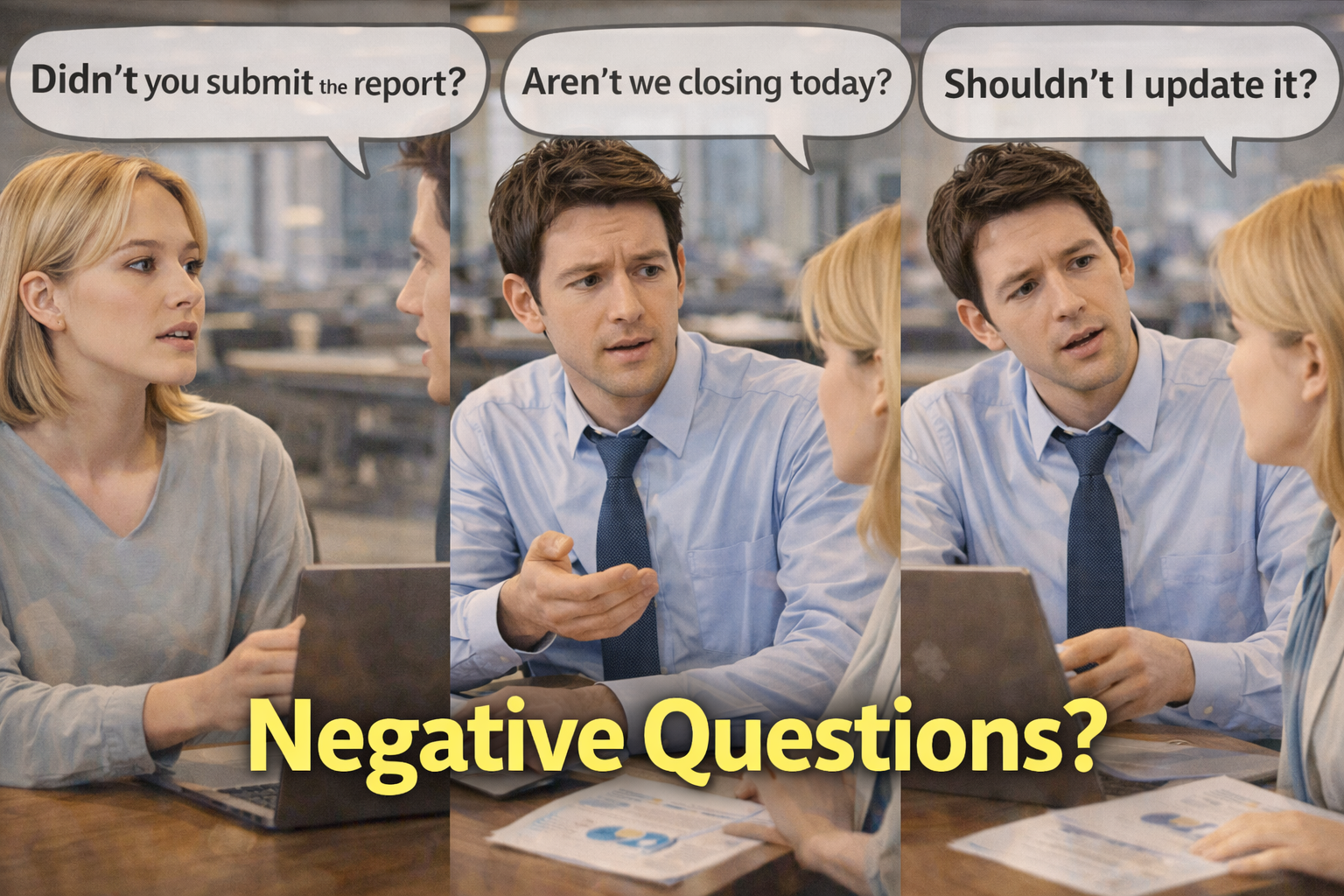
Negative questions are one of the most confusing parts of English communication for learners. In workplace conversations and TOEIC listening sections, speakers often use them to confirm expectations or express surprise. Understanding how to respond correctly is essential because the answer depends on reality, not the negative wording. Mastering this pattern significantly improves comprehension and communication accuracy.
🎧Apple Podcast|Spotify
💬 Dialogue
Emma: Jason, didn’t you submit the expense report yesterday?
Jason: Actually, I uploaded it this morning.
Emma: I see. I must have missed the alert.
Jason: Would you like me to resend it?
Emma: Yes, please. I need to review the numbers.
Jason: Aren’t we closing the accounts today?
Emma: Exactly. That’s why everything needs checking.
Jason: Should I update the travel summary as well?
Emma: That would be helpful.
Jason: I’ll send both files shortly.
Emma: Great. Thanks for following up.
Jason: Anytime.
📚 Vocabulary Boost
| Word / Phrase | IPA | Part of Speech | Meaning | Example Sentence |
|---|---|---|---|---|
| submit | /səbˈmɪt/ | verb | send officially | Please submit the form today. |
| resend | /riːˈsend/ | verb | send again | I will resend the document. |
| review | /rɪˈvjuː/ | verb | examine carefully | She will review the proposal. |
| notification | /ˌnoʊtɪfɪˈkeɪʃən/ | noun | alert message | I missed the notification. |
| update | /ʌpˈdeɪt/ | verb | make current | Please update the file. |
| summary | /ˈsʌməri/ | noun | brief overview | Send a meeting summary. |
| approve | /əˈpruːv/ | verb | officially agree | Management approved it. |
| figure | /ˈfɪɡjər/ | noun | numerical data | Check the figures carefully. |
| follow up | /ˈfɑːloʊ ʌp/ | verb | continue communication | I will follow up later. |
| deadline | /ˈdedlaɪn/ | noun | due date | The deadline is tomorrow. |
🔍 Grammar Points
| Structure / Pattern | Meaning | Example Sentence |
|---|---|---|
| Didn’t + subject + verb? | expectation confirmation | Didn’t you send it? |
| Aren’t + subject + V-ing? | confirming plan | Aren’t we starting now? |
| Haven’t + subject + p.p.? | expected completion | Haven’t you checked it? |
| Isn’t + noun/adjective? | surprise or emphasis | Isn’t this urgent? |
| Negative question + Yes/No logic | answer reality | Yes, I did. |
📖 Transcript
J: So picture this. You are sitting in a really crowded conference room.
J: Right. The air conditioning is blowing just a little too cold.
J: You have all your notes perfectly organized on the table right in front of you.
J: You are feeling super prepared.
J: And then your manager looks up from their laptop.
M: And just locks eyes with you across the table.
J: And they ask just one simple question. “Didn’t you send that email?”
J: And suddenly your mind completely goes blank.
J: You just feel that… that hot flash of sudden panic.
M: That is honestly the absolute worst feeling in the corporate world.
M: The internal monologue just instantly starts racing at a hundred miles an hour.
M: You are sitting there thinking, “Wait, I didn’t send it.
M: Do I say ‘yes, I didn’t send it’ because I am agreeing with the negative reality they just presented?
M: Or do I say ‘no, I didn’t send it’?”
J: And while you are having this massive internal debate over a single syllable, you end up just sitting there, completely frozen, letting an incredibly awkward silence fill the entire boardroom.
M: It is a universally stressful moment.
M: But the reality is, most learners freeze up in these situations not because they lack the vocabulary or the professional skills.
M: It happens because they get misled by the sentence structure itself.
J: They are secretly relying on their native language logic while trying to operate in a high-pressure English environment.
J: So before we fix that and decode exactly how to handle it, let’s officially kick things off. I’m Jason.
M: And I’m Mary. Welcome to Win in 5 Minutes English.
J: Today, we are on a very specific mission.
J: We are going to permanently fix one of the absolute biggest communication traps in Business English: understanding and answering negative questions confidently.
J: Mastering this specific nuance totally changes how you carry yourself in meetings.
J: It really removes that hesitation.
M: When you stop translating the grammar in your head and start responding to the reality of the situation, it replaces that frozen panic with instant professional clarity.
J: To set the stage, let’s look at a typical office interaction.
J: We have a brief exchange here between a manager named Emma and an employee who… who actually happens to be named Jason.
English Dialogue — Office Situation
Emma (Manager): Jason, didn’t you submit the expense report yesterday?
Jason: Actually, I uploaded it this morning.
Emma: Oh, I must have missed the notification.
Jason: No worries. Would you like me to resend it?
Emma: Yes, please. I want to double-check the figures.
Jason: Sure. Aren’t we closing the monthly accounts today?
Emma: Yes, that’s why I’m reviewing everything carefully.
Jason: Got it. Should I also update the travel summary?
Emma: That would help.
Jason: I’ll send both files before noon.
Emma: Perfect. Thanks for staying on top of this.
Jason: Of course!
J: Okay, so analyzing that exchange, we hear two very distinct negative questions right off the bat.
J: First, Emma asks, “Didn’t you submit the expense report yesterday?”
J: And later, Jason asks, “Aren’t we closing the monthly accounts today?”
M: Yeah, the psychology of why native English speakers use these negative questions is really the first hurdle to get over.
M: When you hear “didn’t you” or “aren’t we,” the immediate instinct is to feel defensive.
M: Like it is a trap or an interrogation.
J: Right, like you did something wrong.
M: But in a functional office environment, they usually aren’t trying to trick you at all.
M: These questions are used to confirm progress, or gently remind someone of a task, or simply to express genuine surprise.
M: The underlying feeling is basically: “I was under the impression this was already handled, is that not the case?”
J: Emma honestly thought the report was already in the system.
J: She isn’t inherently accusing Jason of anything.
J: She is just confused about where the document is.
J: But the real challenge is how we actually answer these questions without our brains completely short-circuiting.
J: The cultural language gap here is fascinating.
M: It really is.
M: In many languages, the logic of answering a negative question is based entirely on agreement.
M: So if someone asks, “Didn’t you bring the umbrella?” and you did not bring it, you say “Yes.”
M: Meaning: “Yes, your negative statement is correct, I did not bring it.”
J: But if you apply that logic in an English-speaking office, absolute chaos ensues.
J: If your boss asks, “Didn’t you send the email?” and you say “Yes,” they are going to walk away thinking the email was sent.
M: Which leads to that terrible follow-up conversation an hour later where the boss says, “Wait, you said yes,” and you have to explain, “I meant yes, I didn’t send it.”
J: It sounds almost comical when we say it out loud, but it causes real operational delays.
J: In English, you have to establish a completely different mental framework.
J: You must drop your native language logic entirely and focus solely on the cold, hard facts of the action itself.
J: The structure of the question, whether it is positive or negative, simply does not matter at all.
M: That is the Golden Rule: Fact-Based Answering.
M: If the action was completed, your answer is YES.
M: If the action was not completed, your answer is NO.
M: So the YES or NO is permanently attached to the action itself, ignoring the “didn’t” or “aren’t” at the start of the sentence.
J: So if someone asks, “Didn’t you finish the project?” and you finished it, you just say “Yes, I finished it.”
M: And if you didn’t, you say “No, I didn’t finish it.”
M: It sounds incredibly straightforward when we break it down like that, but overcoming the muscle memory of your native language takes real practice.
J: What I find really effective in the dialogue we just read is how Jason navigates the trap.
J: He completely avoids the raw “Yes” or “No” entirely.
M: Yeah, when Emma asks, “Didn’t you submit the expense report yesterday?”, a simple “No” might feel a bit blunt or defensive.
J: Instead, Jason uses immediate context.
J: He says: “Actually, I uploaded it this morning.”
J: Using a word like “Actually” as a buffer is a brilliant communication strategy.
J: It allows you to smoothly pivot to the facts without awkwardly stumbling over the agreement or disagreement of the negative question.
J: He addresses her confusion instantly by providing the specific, updated timeline.
J: It keeps the conversation moving forward professionally and neutralizes any potential tension.
M: And navigating that tension seamlessly is what separates a proficient English speaker from someone who truly commands the room.
M: Which brings us to the vocabulary side of the equation.
J: Having the grammar logic is the foundation, but pairing it with strategic corporate vocabulary is how you signal competence.
J: Let’s look at the specific words Emma and Jason used, starting with how they handle the movement of documents.
M: The life cycle of office paperwork.
M: The first crucial verb we hear is “submit.”
M: Emma asks about “submitting” the expense report.
J: In a casual setting, you might say “hand in” or “give,” but in a corporate environment or on the TOEIC exam, “submit” carries a necessary weight.
J: It implies a formal transfer of information for official approval.
M: When you tell a client or a manager “I will submit the proposal by Friday,” it establishes a clear professional boundary.
J: And when that submission inevitably hits a technological roadblock—which happens in literally every office—we see the next strategic move.
J: Jason offers: “Would you like me to resend it?”
J: That is a critical point.
J: In a busy office, emails get buried, attachments fail to load, servers crash.
J: When someone says they didn’t get your file, the instinct might be to argue and say, “But I sent it at 9 AM, check your spam folder.”
M: That just creates friction.
M: Offering to simply “resend” the file is proactive.
M: It takes the ego out of the interaction and solves the problem in three seconds instead of starting a five-minute debate about email servers.
J: It shows you are focused on the solution, not the blame.
J: Now, once a document is successfully submitted or resent, it enters the scrutiny phase.
J: Emma says she wants to “double-check” the figures.
J: This introduces a whole new tier of vocabulary.
J: We have “review” and “double-check.”
M: “Reviewing” something isn’t just glancing at it on your phone while you wait for the elevator.
M: It implies a formal, careful inspection.
M: A manager “reviewing” a budget is looking for discrepancies, ensuring compliance, and verifying accuracy.
M: “Double-check” amplifies that.
M: You are verifying something that has already been verified.
M: It is the ultimate safety net in Business English.
J: And notice the specific noun Emma uses.
J: She doesn’t say she wants to double-check the “numbers.”
J: She says she wants to double-check the “figures.”
J: In casual conversation, sure, you check the numbers.
J: But in formal Business English, financial reports, or TOEIC reading comprehension passages, “figures” is the standard terminology.
J: It is used for official statistics, financial data, or calculated amounts.
J: Saying “I am reviewing the figures” signals a much higher level of executive presence than saying “I am looking at the numbers.”
J: It subtly communicates that you are dealing with significant data, not just doing basic arithmetic.
J: It is those small vocabulary upgrades that change how colleagues perceive your competence.
J: Moving further into the dialogue, we see how they handle keeping the broader team informed, which is the absolute cornerstone of the modern digital workspace.
J: Jason asks, “Should I also update the travel summary?”
M: The verb “update” is the engine of corporate communication.
M: The business world moves incredibly fast, and outdated information is useless.
M: To “update” a document is to bring it completely into the present moment.
M: But the noun he pairs it with, “summary,” is equally vital.
M: Managers and executives are universally pressed for time.
J: They rarely want to read a 50-page raw data report if they can avoid it.
J: They want the synthesized highlights.
M: A “summary” distills the complex information into actionable points.
M: When you are tasked with providing a summary, whether it is of a business trip or a quarterly earnings call, you are being trusted to filter out the noise and present only what actually matters.
J: And speaking of digital noise, let’s talk about the most relatable moment in that entire dialogue.
J: Emma realizes she missed Jason’s upload and says, “Oh, I must have missed the notification.”
M: A “notification” is just an alert, a ping from your team chat or an email pop-up.
M: But the way Emma uses it here is a masterclass in polite office politics.
J: It really is.
J: “I must have missed the notification” is the ultimate face-saving phrase.
M: If she said “I forgot to check the folder,” she takes on the blame for the delay.
M: By blaming the notification, she shifts the fault slightly to the technology.
M: The software failed to alert her adequately.
M: It is a highly polite, non-confrontational way to acknowledge a missed connection without sounding incompetent.
J: Having that phrase in your back pocket is incredibly useful when you inevitably miss an email in a flooded inbox.
J: It preserves the professional relationship perfectly.
J: Finally, the dialogue wraps up by touching on broader office milestones and proactive behaviors.
J: Jason asks, “Aren’t we closing the monthly accounts today?”
M: The phrase “account closing” refers to the end-of-month or end-of-year process where all financial records are locked.
M: If you work anywhere near a finance department, “account closing” is a sacred phrase.
M: It is a recognized boundary.
M: When a team announces they are closing accounts, it is universally understood as “do not interrupt us unless it is a severe emergency.”
J: And Emma ends the exchange by thanking Jason for “staying on top of this.”
M: While the exact phrase “follow-up” isn’t used, “staying on top of something” is the practical execution of following up.
M: It means taking full ownership of a task, anticipating the next steps, and ensuring nothing falls through the cracks.
M: In corporate culture, being the person who reliably follows up on moving pieces makes you indispensable.
J: Synthesizing all of this—the strategic vocabulary like “figures,” “summaries,” and “resending” documents—builds a tremendous foundation for both your daily work and your TOEIC exams.
J: But the real magic happens when you pair those high-level words with a calm, fact-based response to a negative question.
J: You stop being the person who freezes in the conference room and start being the person who drives the meeting forward.
M: So as we look to wrap up, I want to connect this directly back to your next work day.
M: Next time you are in a meeting and someone hits you with a “Didn’t you” or an “Aren’t we,” take a breath.
M: Do not try to translate the grammar.
M: Do not worry about agreeing or disagreeing with the negative structure.
M: Just look at the reality of the situation.
M: Did you complete the action? YES.
M: Did you not complete it? NO.
J: Notice during your next office interaction whether a colleague asking “Didn’t you?” sounds genuinely surprised.
J: If their pitch is higher and their cadence is light, they honestly just missed the information, much like Emma did.
J: In that case, you simply clarify the facts.
J: But if their pitch drops, if their tone sounds slightly flat, rigid, or clipped, that subtle audio cue changes everything.
M: That flat tone usually means frustration.
M: It is the subtle cue that they expected this task to be completed yesterday and they are annoyed that they even have to ask.
J: And if you hear that frustration, a purely factual “Yes, I did” or “No, I didn’t” might come across as defensive or tone-deaf.
J: If the tone is frustrated, you might need to pair your factual answer with a quick professional reassurance or an apology for the delay.
J: Listening for that underlying tone—that emotional subtext—is the next crucial step in achieving true fluency and mastering office dynamics.
M: Well, we have covered a significant amount of territory today.
M: Moving from the psychological freeze of negative questions to the liberating fact-based response, and exploring how strategic vocabulary can elevate your entire professional presence.
M: Hopefully, you’re walking into your next meeting feeling equipped to handle whatever questions come your way without a second of hesitation.
J: Remember, 5 minutes a day is all you need to win at work, win the TOEIC, and win over your colleagues.
J: If you found this episode useful, don’t forget to follow and share it with your friends.
J: Thanks for tuning in everyone. See you next time.
M: Goodbye everyone. Take care.


Comments