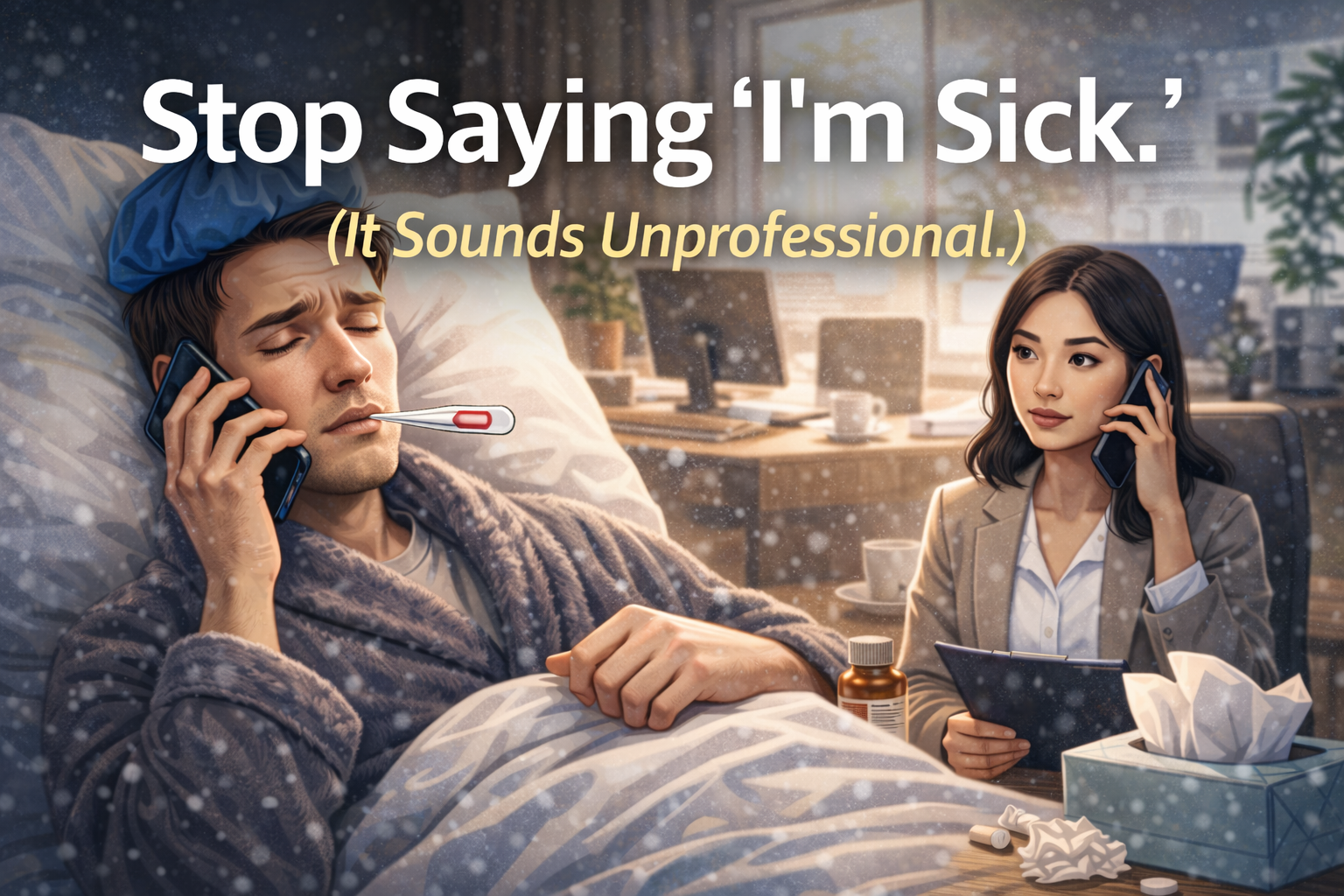
Calling in sick is a common workplace situation—and it shows up frequently on the TOEIC exam in office dialogues and email notices. Simply saying “I’m sick” is understandable, but it often sounds incomplete in professional settings.
In this lesson, you’ll learn high-frequency TOEIC phrases for sick leave, including how to explain your absence, arrange coverage, and reschedule meetings—so you can communicate clearly at work and perform better on the TOEIC exam.
🎧Apple Podcast|Spotify
💬 Dialogue (Scenario: Calling in Sick)
Mina (Project Manager): Morning, Leo. Are you still joining the 10 a.m. client call?
Leo (Team Member): Hi Mina. I’m not feeling well today, so I’d like to take sick leave.
Mina: Thanks for letting me know. Is it a full day or just this morning?
Leo: Probably a full day. I have a fever and I’m going to see a doctor.
Mina: Got it. Do you have any urgent tasks we should cover?
Leo: Yes—could you ask Anna to handle the client call and share the notes with me?
Mina: Sure. I’ll reassign it and update the agenda.
Leo: Thank you. I’ll also send an email to the client to reschedule the follow-up meeting.
Mina: Great. Please keep your out-of-office message on, so people know you’re unavailable.
Leo: Will do. If you need a doctor’s note, I can provide it tomorrow.
Mina: That’s helpful. Rest up and feel better.
📚 Vocabulary Boost — Key TOEIC Words
| Word / Phrase | IPA | Part of Speech | Meaning | Example Sentence (bold target word) |
|---|---|---|---|---|
| sick leave | /ˈsɪk liːv/ | noun phrase | time off due to illness | I’d like to take sick leave today. |
| call in sick | /kɔːl ɪn sɪk/ | verb phrase | report you are sick | He called in sick this morning. |
| not feeling well | /nɑːt ˈfiːlɪŋ wɛl/ | phrase | feeling unwell | I’m not feeling well today. |
| fever | /ˈfiːvər/ | noun | high temperature | I have a fever. |
| urgent | /ˈɝːdʒənt/ | adj. | requiring immediate action | Please flag any urgent requests. |
| cover | /ˈkʌvər/ | verb | take over temporarily | Can you cover my shift today? |
| handle | /ˈhændl/ | verb | manage/deal with | Anna will handle the client call. |
| reassign | /ˌriːəˈsaɪn/ | verb | assign again | I’ll reassign the task. |
| reschedule | /ˌriːˈskedʒuːl/ | verb | move to a new time | We need to reschedule the meeting. |
| doctor’s note | /ˈdɑːktərz noʊt/ | noun phrase | medical certificate | I can provide a doctor’s note if needed. |
🔍 Grammar Points
| Structure / Pattern | Meaning | Example Sentence |
|---|---|---|
| I’d like to + V | polite request | I’d like to take sick leave today. |
| Are you still + V-ing? | confirmation | Are you still joining the call? |
| Do you have any…? | checking items | Do you have any urgent tasks? |
| Could you + V…? | polite request | Could you ask Anna to cover the call? |
| If needed, I can + V | offering backup | If needed, I can provide a doctor’s note. |
📖 Transcript
J: Have you ever had that moment? You wake up, you feel absolutely terrible, and you just stare at your phone and freeze.
M: Oh, yeah.
J: It’s that panic of how to text your boss. You start thinking, “Am I giving them too much detail?” or “Is this too little?”
M: Please just don’t send a picture of the thermometer. Nobody needs that.
M: But I totally get the anxiety. You want to sound professional, but you also don’t want to, you know, overshare. It’s a fine line.
J: Exactly. You want to sound responsible, even when you’re just hiding under a blanket.
M: Welcome to Win in 5 Minutes English. I’m Mary.
J: And I’m Jason. Today we’re talking about the professional way to ask for sick leave.
M: And this isn’t just about office etiquette; it’s a huge part of business communication.
J: So, we’re going to listen to a quick conversation. It’s between a team member, Leo, and his manager, Mina. Leo needs to take the day off.
M: Okay, pay close attention to how he handles it.
Dialogue (Scenario: calling in sick)
Mina (Project Manager): Morning, Leo. Are you still joining the 10 a.m. client call?
Leo (Team Member): Hi Mina. I’m not feeling well today, so I’d like to take sick leave.
Mina: Thanks for letting me know. Is it a full day or just this morning?
Leo: Probably a full day. I have a fever and I’m going to see a doctor.
Mina: Got it. Do you have any urgent tasks we should cover?
Leo: Yes—could you ask Anna to handle the client call and share the notes with me?
Mina: Sure. I’ll reassign it and update the agenda.
Leo: Thank you. I’ll also send an email to the client to reschedule the follow-up meeting.
Mina: Great. Please keep your out-of-office message on, so people know you’re unavailable.
Leo: Will do. If you need a doctor’s note, I can provide it tomorrow.
Mina: That’s helpful. Rest up and feel better.
J: Okay, that was incredibly smooth.
M: Right. He sounded so professional even while feeling awful.
J: The first thing I noticed was his word choice. He didn’t just say “I’m sick,” he said “I’d like to take sick leave.”
M: Yes. That’s such a key difference. “I’m sick” is just a physical state.
J: It’s a complaint, almost.
M: But “taking sick leave,” that frames it as an official request. It’s an HR term. It’s a transaction.
J: Right. And he didn’t just leave his boss hanging. He came with a plan. He asked if Anna could handle the client call.
M: To handle something just means to take care of it, to manage it.
J: And Mina’s reply completes that thought. She said she’d reassign it.
M: And those two words, “handle” and “reassign,” are just gold for TOEIC.
J: They show that he’s not dumping a problem.
M: He’s proposing a coverage plan.
J: And speaking of plans, he also used the word “reschedule.” He didn’t just cancel the meeting.
J: Then there was that other key bit of logistics: the out-of-office message.
M: The auto-reply. In a global company, forgetting that is a major sin. Your clients will just think you’re ignoring them.
J: For sure. And finally, he offered the doctor’s note.
M: Which is just the standard phrase for that medical proof you get from a clinic.
J: But beyond the vocabulary, I loved the grammar he used. He was so polite. “I’d like to.”
M: It’s a soft way to state what you need. But what about that last part, the “if I can” sentence?
J: “If you need a doctor’s note, I can provide it tomorrow.”
J: He anticipates what the manager might need before she even has to ask. It’s a contingency plan. It shows he’s thinking ahead, and that’s incredibly reassuring for a boss.
M: So I guess the main takeaway here is pretty clear. In business English, it’s okay to be sick. Everyone gets sick.
J: But failing to communicate your plan for coverage, that’s the real problem.
M: It’s all about showing that you’re still responsible for your work even when you’re not there.
J: That’s it for today’s Win in 5 Minutes English. Remember, five minutes a day is all you need to win at work, win the TOEIC, and win over your colleagues.
M: If you found this useful, don’t forget to follow and share it with your friends.
J: See you next time!
M: BYE!


Comments