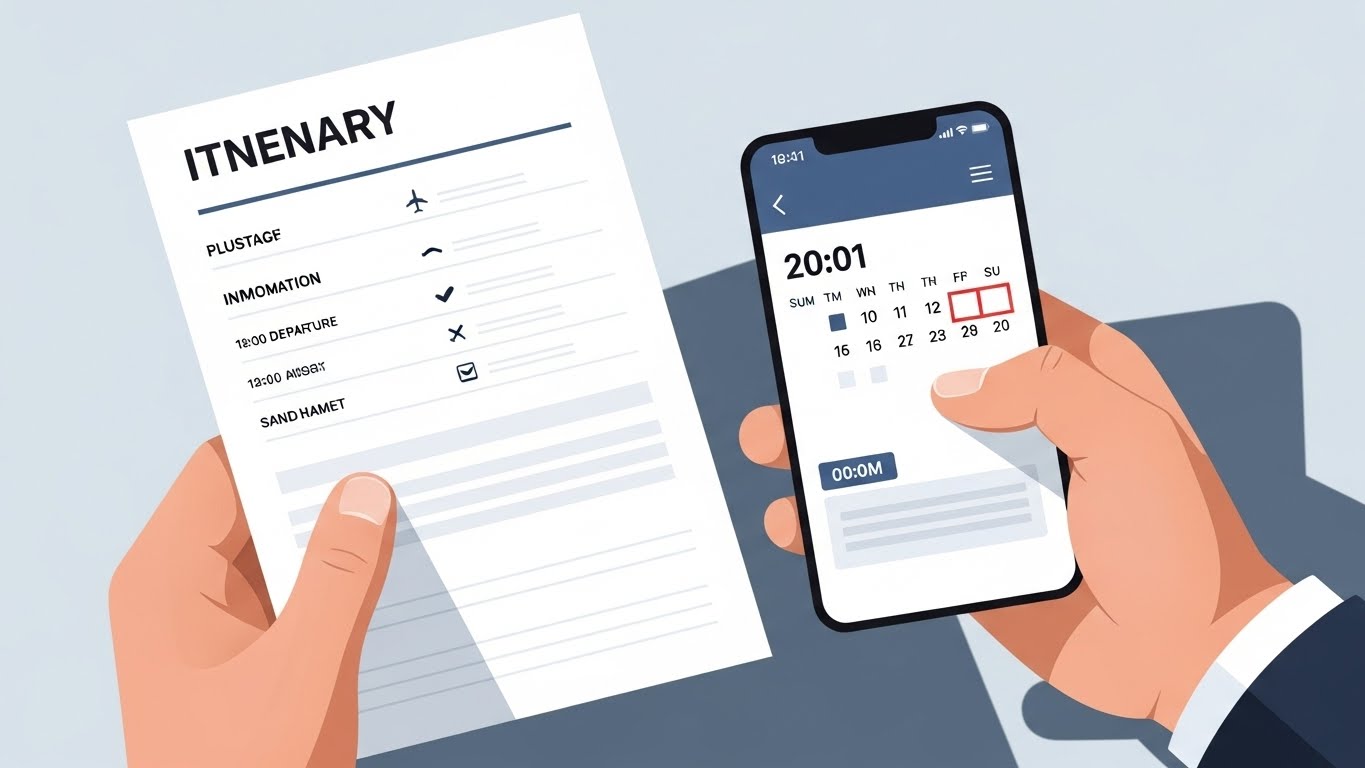
Planning a business trip is not only a common workplace task — it’s also one of the most frequently tested scenarios in the TOEIC exam.
Whether you’re discussing destinations, checking flight options, adjusting your itinerary, or coordinating with colleagues, these phrases appear again and again in TOEIC Listening and Reading.
In this lesson, you’ll get a realistic business-focused dialogue filled with expressions, plus vocabulary, grammar, and a short quiz to help reinforce the key patterns.
Let’s get you ready for both the test and your next real business trip.
🎧Apple Podcast|Spotify
💬 Dialogue
📍 Scenario:
Two colleagues are planning an upcoming business trip for early January. They must decide on destinations, compare flights, review schedules, and confirm the itinerary.
English Dialogue
Sarah: Hey Mark, have you finalized the destination for our business trip next month?
Mark: Not yet. The client wants us to visit either Chicago or Dallas. Which one do you think we should prioritize?
Sarah: Probably Chicago. Their team requested an in-person meeting. Have you checked the flight options?
Mark: Yes, I checked this morning. The fares went up again. We should probably book soon before the seats sell out.
Sarah: Agreed. Do you want to review the flight schedules together?
Mark: Sure. I also want to compare airlines — some include Wi-Fi and extra baggage, which might be useful for the presentation equipment.
Sarah: Good thinking. What about traveling from the 8th to the 11th? That seems like the smoothest itinerary.
Mark: Works for me. Do you prefer a morning departure or something later?
Sarah: Morning is fine. I’d like to arrive early and prepare before meeting the client.
Mark: Same here. Let’s check availability. If the seats are still open, we should book today.
Sarah: Great. I’ll pull up the booking site now. Hopefully the prices haven’t increased again.
Mark: Yeah, business travel in January is always busy.
📚 Vocabulary Boost (TOEIC High-Frequency Words)
| Word / Phrase | Part of Speech | Meaning | Example Sentence | Notes |
|---|---|---|---|---|
| fare | noun | ticket price | The flight fare increased due to high demand. | Common in travel announcements |
| itinerary | noun | travel schedule | Please confirm the itinerary before we submit it to the client. | Often appears in TOEIC Part 7 |
| availability | noun | open seats/rooms | We need to check seat availability for the morning flight. | Used in booking situations |
| fully booked | adjective | no seats/rooms left | Most flights to Chicago are already fully booked. | Reflects real travel peak season |
| reservation | noun | booking | Your reservation has been completed successfully. | Email confirmations |
| departure | noun | leaving time | The departure time has changed to 9:20 a.m. | Found in airport announcements |
| compare | verb | evaluate options | Let’s compare the fares before making a decision. | Decision-making context |
| went up | phrase | increased | Prices went up again this week. | TOEIC focuses on trends |
| business trip | noun | work-related travel | Our business trip is scheduled for early January. | Core TOEIC theme |
| meeting request | noun | client-requested meeting | The client sent a meeting request for the 10th. | Useful in email tasks |
🔍 Grammar Focus (TOEIC Common Patterns)
| Grammar Pattern | Meaning | Example Sentence | Explanation |
|---|---|---|---|
| be leaning toward + option | considering a choice | I’m leaning toward flying to Chicago. | Polite preference |
| be fully booked | completely sold out | The morning flight is fully booked already. | Common in travel dialogues |
| be thinking about + V-ing | considering an action | We’re thinking about traveling on the 8th. | Soft suggestion |
| before + V-ing | sequence | Let’s confirm with the client before booking anything. | Shows order of actions |
| need to + V | necessity | We need to check availability soon. | Strong requirement, very TOEIC-like |
📖 Transcript
J: Welcome back to Win in 5 Minutes English, everyone. Today we’re going to get into something that, well, almost everyone in a business setting has to do at some point.
M: Planning a business trip.
J: Exactly. The logistics, the pressure, all of it. And it’s a classic scenario you’ll see on the TOEIC exam too, so this should be really useful.
M: Right. So we’re looking at a conversation between two colleagues, Sarah and Mark. They’re trying to plan a trip for early January.
J: So, you know, a really busy time.
M: A very busy time. They’re dealing with destinations, flights, schedules… all the typical stuff.
Two colleagues are planning an upcoming business trip for early January. They must decide on destinations, compare flights, review schedules, and confirm the itinerary.
English Dialogue
Sarah: Hey Mark, have you finalized the destination for our business trip next month?
Mark: Not yet. The client wants us to visit either Chicago or Dallas. Which one do you think we should prioritize?
Sarah: Probably Chicago. Their team requested an in-person meeting. Have you checked the flight options?
Mark: Yes, I checked this morning. The fares went up again. We should probably book soon before the seats sell out.
Sarah: Agreed. Do you want to review the flight schedules together?
Mark: Sure. I also want to compare airlines — some include Wi-Fi and extra baggage, which might be useful for the presentation equipment.
Sarah: Good thinking. What about traveling from the 8th to the 11th? That seems like the smoothest itinerary.
Mark: Works for me. Do you prefer a morning departure or something later?
Sarah: Morning is fine. I’d like to arrive early and prepare before meeting the client.
Mark: Same here. Let’s check availability. If the seats are still open, we should book today.
Sarah: Great. I’ll pull up the booking site now. Hopefully the prices haven’t increased again.
Mark: Yeah, business travel in January is always busy.
J: Okay, so let’s just run through what they said. It’s a pretty quick exchange. So, Sarah kicks it off, asking if they’ve decided on the destination yet. The client gave them two options: Chicago or Dallas.
M: And Mark says he just checked the fares this morning and, guess what? They went up again.
J: They went up again. Yeah. So he’s stressing that they really need to book soon.
M: Right. Then they get into the details, like comparing airlines, looking for Wi-Fi, you know, extra baggage allowance.
J: And they confirm the dates, the 8th to the 11th, and decide on a morning flight so they can get there early and prep before meeting the client.
M: That short conversation… I mean, it is just packed with really useful language.
J: It is. So let’s unpack some of the vocabulary they use. These are words that pop up all the time in business and on the exam.
M: Okay, let’s start with “fare.” When Mark says the fare went up, he’s not just stating a fact, is he?
J: Not at all. He’s creating urgency. A “fare” isn’t just a price tag; in this context, it’s a variable, a risk. The cost is rising, and that means the window to act is closing.
M: Right. It demands action. And what about “itinerary”? Everyone kind of knows what it means, but here, it’s more than just a schedule.
J: When they confirm the dates, that itinerary becomes, like a project plan. It’s a commitment. You have to lock it in before you can present it to anyone else, especially the client.
M: And they also touched on “availability” and the risk of things being fully booked.
J: Which is a huge deal in early January. Checking for availability isn’t just about finding a seat. It’s about securing a resource before your competitors do. Or before it’s just gone.
J: Totally. And that phrase he used, “went up,” is just a perfect, natural way to talk about an increase. Prices, numbers, anything. It’s simple and direct.
M: So that’s the vocabulary. But the way they structure their sentences is also super important for getting things done.
J: Oh, absolutely. The grammar here tells its own story about how to communicate effectively. So let’s look at when Mark says, “we need to check availability soon.” That “need to” plus a verb, it’s powerful.
M: It’s not a suggestion. It signals that something is mandatory. It’s about necessity. If you don’t do this, there will be negative consequences.
J: And you can contrast that with something a little softer, like when they say, “I’m leaning toward flying to Chicago.”
M: I love that phrase: “be leaning toward” an option. It’s a brilliant way to state your preference without sounding too aggressive.
J: It keeps the conversation collaborative, you know? It invites other people to chime in.
M: Exactly. And one last one. Using “before” plus “V-ing.” Like, “preparing before meeting the client.”
J: It establishes a clear sequence. You do this first, then you do that. It’s how you manage complex tasks.
M: “Let’s confirm with the team before booking the tickets.” Simple, clear, and it prevents mistakes.
J: So really, it all comes together. The words they choose and the way they phrase things helps them manage the cost, the urgency, and the teamwork all at the same time.
J: That’s it for today’s Win in 5 Minutes English. Remember, 5 minutes a day is all you need to win at work, win the TOEIC, and win over your colleagues. If you found this episode useful, don’t forget to follow and share it with your friends. See you next time.


Comments