order #02 · Office Daily English
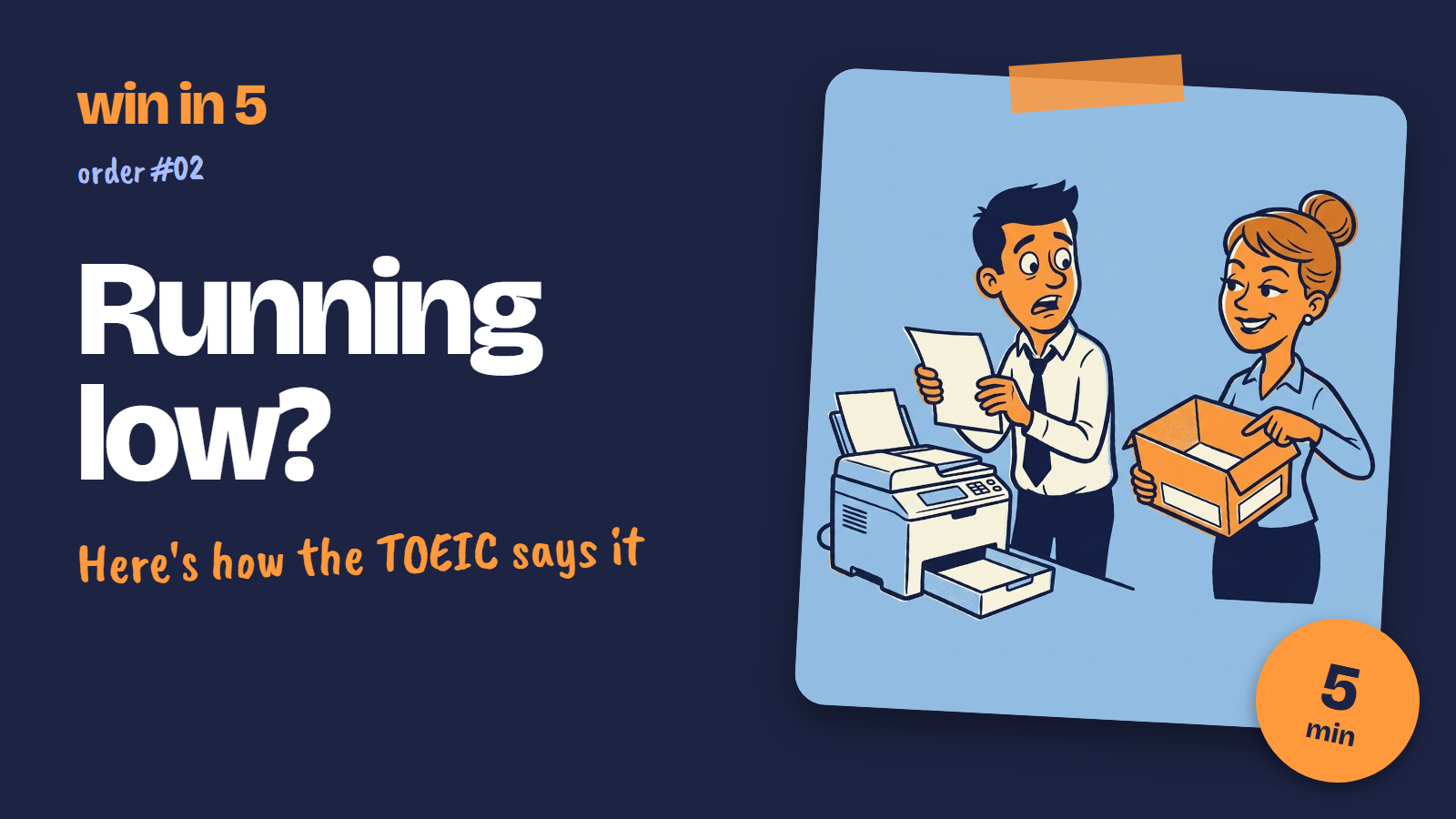
Something important is about to run out at the office. Tom and Grace sort it out in under a minute, and every phrase they use is one the TOEIC likes to say in different words.
Part 3 = Conversations: answer questions about a short conversation.
Part 4 = Talks: answer questions about a short announcement or message.
The short answer
On the TOEIC, the right answer often says what you heard in different words.
If an answer choice repeats a word from the audio, slow down. It may be a trap.
First, listen in
Grace is an office manager. On Tuesday morning, Tom comes to her desk with a problem at the printer.
Today’s menu
6 phrases, in the order you hear them.
running low
There's still some left, but not much.
place an order
The professional way to say "buy" or "order."
out of stock
The seller doesn't have the item right now.
run out
To have none left.
tipRunning low is the warning. Running out is the problem you're trying to avoid.
express delivery
Fast shipping.
at the latest
No later than Thursday. It could come earlier, but not after.
today’s cheat sheet
Say it another way
win in 5 · #02
What you hear in the conversation, and how it can show up on the TOEIC.
could be the right answerbe carefulNumbers match the phrases above.
1running low
2place an order
3out of stock
QOn the test, question: What problem does the woman mention?
AAnswer: A supplier cannot provide an item.
5express delivery
QOn the test, question: What will the woman probably do next?
A future statement like “I'll …” near the end is often the answer.
toeic.mjenglishclass.com
The big lesson
If an answer choice repeats a word you heard, slow down. That choice may be a trap. The correct answer usually says the same thing in different words.
Now, listen again
The conversation plays one more time. Tap each phrase when you hear it. 0 / 6
Order complete · nice ears
Your turn
One TOEIC-style question. Tap your answer.
“What problem does the woman mention?”
Try it today
“We're running low. Can we place an order today?”
Use it when something at work is almost gone.
Read the full transcript
Welcome to Win in 5 Minutes English. I'm Jason. Today we're looking at a problem every office runs into sooner or later: something important is about to run out. We just heard Tom and Grace deal with it in under a minute. And here's why it matters for the TOEIC. In Parts 3 and 4, the correct answer often uses different words from the ones you heard. It paraphrases them. So let's go through the key phrases one by one, and I'll show you how the test might say the same thing.
First, Grace says, "We're running low." Running low means there's still some left, but not much. On the test, you might hear it as "supplies are limited" or "there isn't much left." If an answer choice says "there is no paper at all," be careful. That's not what running low means.
Next, Tom asks, "Can we place an order today?" To place an order is the professional way to say "buy" or "order." In an answer choice, it might become "make a purchase" or "request more items."
Then Grace says, "Our usual supplier is out of stock." Out of stock means the seller doesn't have the item right now. This is one of the most common paraphrase pairs on the TOEIC. Out of stock can become "unavailable," "sold out," or "not available." If the question asks, "What problem does the woman mention?" the answer might be, "A supplier cannot provide an item." Different words, same idea.
Now listen to Tom: "We can't run out before the board meeting." To run out means to have none left. Notice the difference. Running low is a warning. Running out is the problem you're trying to avoid.
Grace's solution is, "Okay. I'll order ten boxes and ask for express delivery." Express delivery means fast shipping. On the test, it could be "faster shipping" or "expedited delivery." And a future statement like "I'll" near the end of a conversation is often the answer to the question, "What will the woman probably do next?"
Last one: "By Thursday at the latest." At the latest means no later than Thursday. It could come earlier, but not after.
Here's the big lesson. If an answer choice repeats a word you heard, slow down. That choice may be a trap. The correct answer usually says the same thing in different words. Now, I want you to listen to that conversation one more time. This time, try to catch every phrase the TOEIC could paraphrase.
How many did you catch? Running low, place an order, out of stock, run out, express delivery, and at the latest. On the test, expect to hear each of them in different words. Here's one to try today: if something's almost gone at work, say, "We're running low. Can we place an order today?" The cheat sheet with every paraphrase from today is waiting for you in the link below.
Remember, five minutes a day is all you need to win at work, win the TOEIC, and win over your colleagues. May your printer never run out of paper. Talk soon!


Comments