order #03 · Meeting English
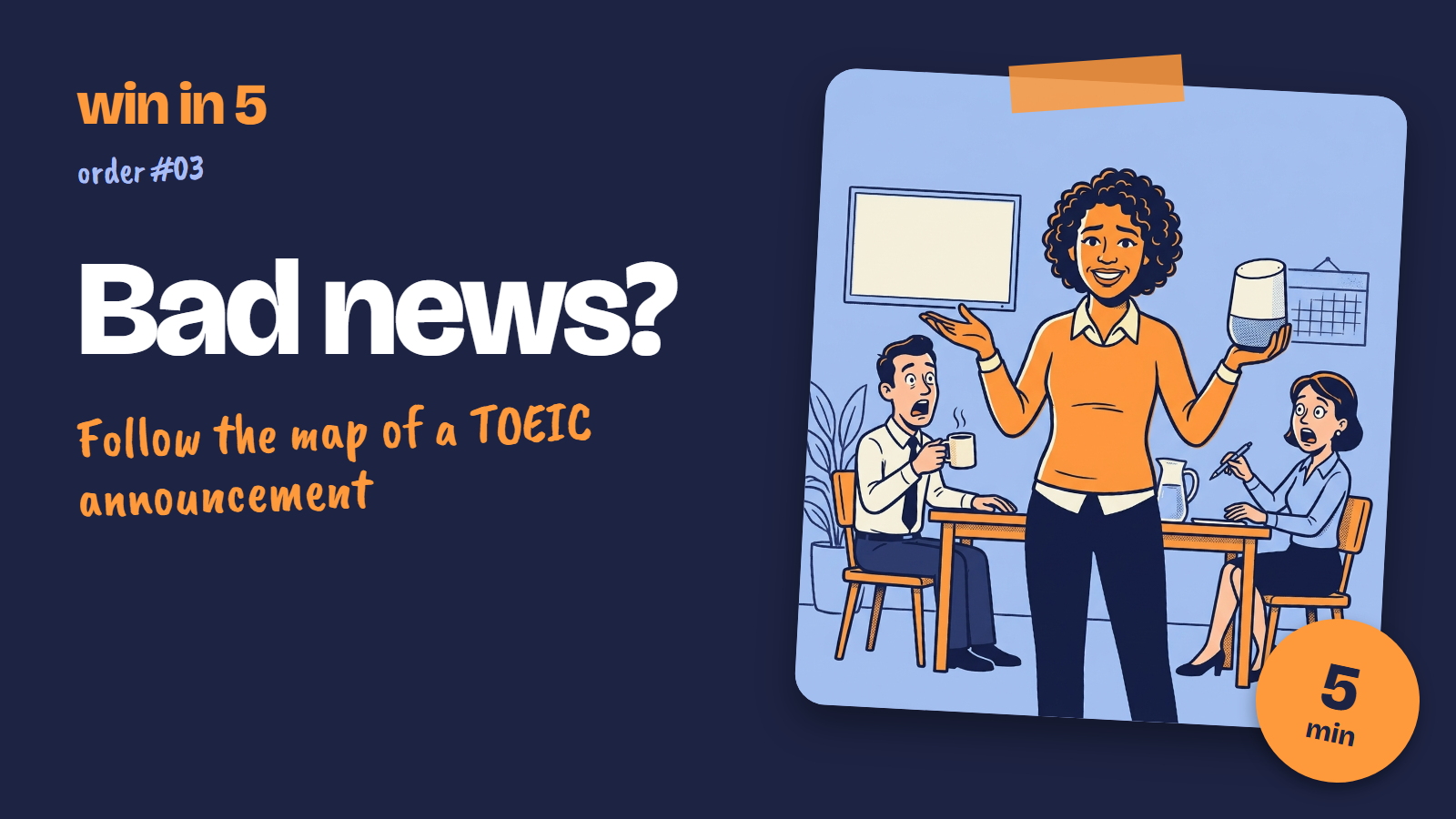
Olivia tells her team that a product launch is moving. It's a classic TOEIC Part 4 talk: one speaker, a short announcement, and three questions. Once you know where each answer usually sits, it gets much easier.
Part 4 = Talks: answer questions about a short announcement or message.
The short answer
TOEIC Part 4 announcements follow a map.
The purpose comes first, “unfortunately” brings the problem, “in the meantime” points to what's next, and “please” tells listeners what to do.
First, listen in
Olivia is a product manager at a home electronics company. At Monday's staff meeting, she has some news about a new product.
Today’s menu
6 phrases, in the order you hear them.
I have an update on
Tells you the topic right away.
tipYou'll also hear “I'd like to let you know” or “I'd like to share some news.”
unfortunately
A signal word. When you hear it, a problem is usually coming.
postpone
Move to a later date.
one of the parts
The reason for the delay.
in the meantime
While we wait. It often points to what happens next.
tipNext-step answers usually sit near the end of the talk.
please … by Wednesday
A polite request. It tells the listeners what to do.
today’s cheat sheet
Say it another way
win in 5 · #03
What you hear in the conversation, and how it can show up on the TOEIC.
could be the right answerbe carefulNumbers match the phrases above.
1I have an update on
QOn the test, question: What is the purpose of the announcement?
The answer is often in the first few sentences.
3postpone
4one of the parts
QOn the test, question: Why was the launch delayed?
AAnswer: A supplier cannot deliver a component.
“Part” became “component.” That's a classic TOEIC paraphrase.
6please … by Wednesday
QOn the test, question: What are the listeners asked to do?
AAnswer: Submit questions by Wednesday.
A request with “please” near the end is often the answer.
toeic.mjenglishclass.com
The big lesson
Purpose first. "Unfortunately" for the problem. The reason right after. "In the meantime" for what's next. "Please" for what the listeners should do.
Now, listen again
The conversation plays one more time. Tap each phrase when you hear it. 0 / 6
Order complete · nice ears
Your turn
One TOEIC-style question. Tap your answer.
“Why was the launch delayed?”
Try it today
Next time you read a company email, look for “unfortunately” and see what comes right after it.
Read the full transcript
Welcome to Win in 5 Minutes English. I'm Jason. Today we're listening to something you'll hear in almost every office: an announcement about a delay. We just heard Olivia tell her team that a product launch is moving. And this is a classic TOEIC Part 4 talk: one speaker, a short talk, and three questions. The good news is that announcements follow a pattern. Once you know where each answer usually sits, they get much easier.
Let's start at the top. Olivia says, "Before we start, I have an update on the SoundWave speaker." The first question is often, "What is the purpose of the announcement?" And the answer is often in the first few sentences. "I have an update on" tells you the topic right away. You'll also hear "I'd like to let you know" or "I'd like to share some news."
Next, the bad news: "Unfortunately, we've decided to postpone the launch until April fifteenth." Unfortunately is a signal word. When you hear it, a problem is usually coming. And postpone means move to a later date. In an answer choice, it might be "delay" or "reschedule."
Then comes the reason: "Our supplier is having trouble delivering one of the parts." If a question asks, "Why was the launch delayed?" the answer might be, "A supplier cannot deliver a component." Notice that "part" became "component." That's a classic TOEIC paraphrase.
Next, listen for "In the meantime." It means while we wait. It often points to what happens next, and next-step answers usually sit near the end of the talk. Here, the marketing team will update the launch materials, and customer service will contact everyone who pre-ordered.
And finally: "If you have any questions, please send them to me by Wednesday." A request with "please" near the end is often the answer to "What are the listeners asked to do?" Submit questions by Wednesday.
So here's the map. The purpose often comes first. Unfortunately usually signals the problem. The reason often comes right after. In the meantime points to what's next. And please near the end usually tells you what the listeners should do. Now, I want you to listen to Olivia one more time. This time, follow the map and listen for each signal phrase.
Did the map work that second time? The signals were: I have an update on, unfortunately, in the meantime, and please near the end. Once you know them, a Part 4 talk becomes a map instead of a wall of words. Try this today: the next time you read a company email, look for the word "unfortunately" and see what comes right after it. I've put today's phrase map on the website, so you can see every signal side by side. The link is below.
Remember, five minutes a day is all you need to win at work, win the TOEIC, and win over your colleagues. Next time someone says "unfortunately," you'll know exactly what's coming. Until next time!


Comments