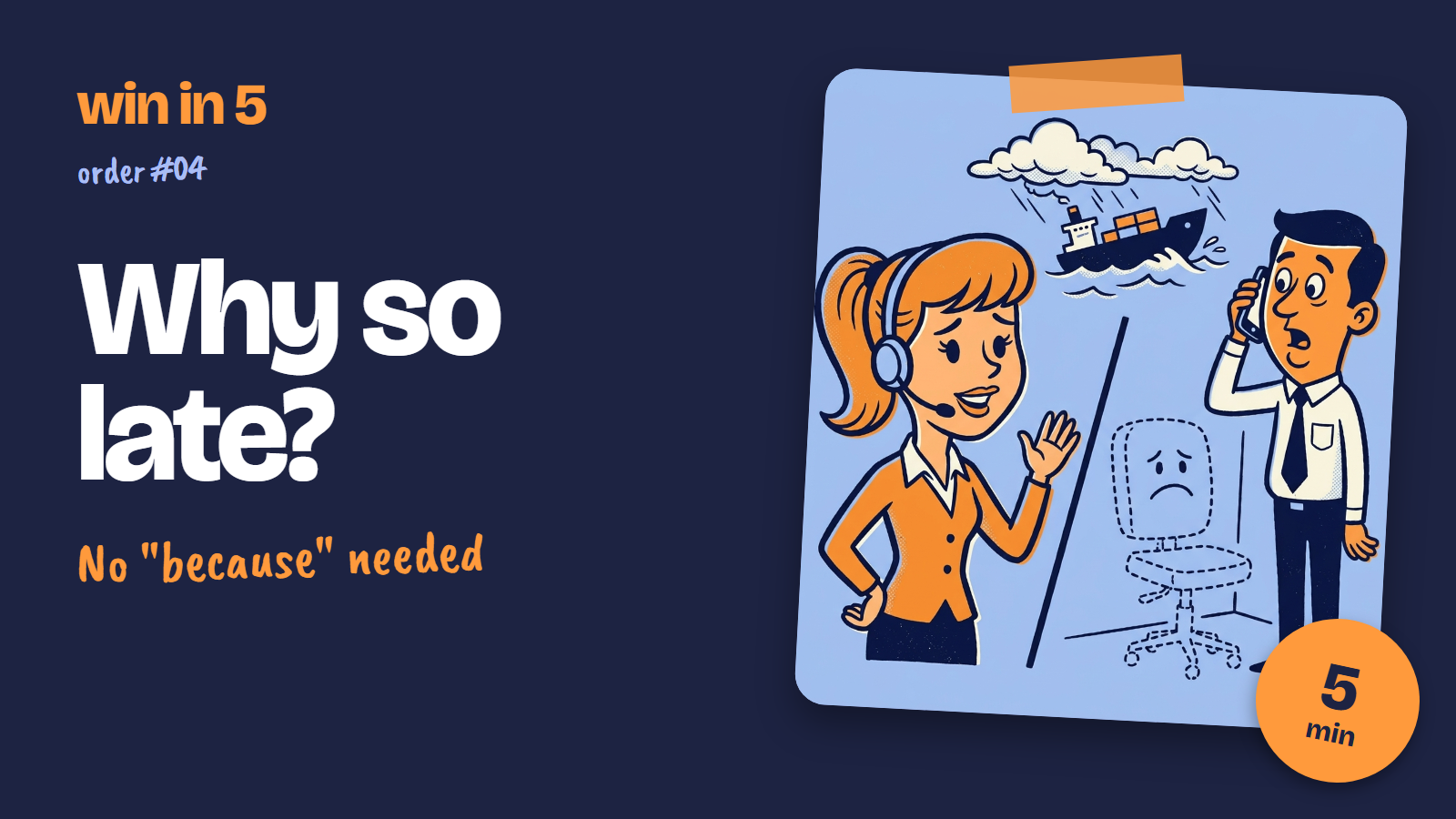
order #04 · Telephone English
An order of office chairs is late, and the customer wants to know why. Rachel answers every "why" without saying "because" once, and every answer still works.
Part 2 = Question–Response: hear a question, pick the best reply.
The short answer
You don't need “because” to answer a “why” question.
On the TOEIC, a simple fact or “to” plus a verb can be the right answer.
First, listen in
Rachel works in sales at an office supply company. One morning, she has to call her client Mark with some bad news about his order.
Today’s menu
6 phrases, in the order you hear them.
I'm afraid there's a delay.
A polite way to soften bad news. It doesn't mean she's scared.
won't arrive until Friday
Friday is the earliest they'll arrive.
There was a storm
A reason without "because." Answers starting with "There was" can answer "why."
We only got the update this morning.
A simple fact that explains everything.
to make up for it
To do something to fix or balance a problem you caused.
tip"To + verb" explains a purpose. It's another way to answer "why."
take ten percent off
Give a discount.
today’s cheat sheet
Say it another way
win in 5 · #04
What you hear in the conversation, and how it can show up on the TOEIC.
could be the right answerbe carefulNumbers match the phrases above.
2won't arrive until Friday
3There was a storm
QOn the test, question: Why is it taking so long?
AAnswer: There was a storm at the port.
An answer that starts with “There was” can answer “why.”
4We only got the update this morning.
QOn the test, question: Why didn't anyone tell us sooner?
AAnswer: We only got the update this morning.
Simple facts like this can be correct answers in Part 2.
6take ten percent off
watch out
Sometimes the option that starts with “because” doesn't actually answer the question.
toeic.mjenglishclass.com
The big lesson
When you hear "why," don't wait for "because." Listen for the reason, not the word.
Now, listen again
The conversation plays one more time. Tap each phrase when you hear it. 0 / 6
Order complete · nice ears
Your turn
One TOEIC-style question. Tap your answer.
“Why is it taking so long?”
Try it today
Next time someone at work asks you “why,” give the reason as a simple fact, or with “to” plus a verb, and skip “because.”
Read the full transcript
Welcome to Win in 5 Minutes English. I'm Jason. Nobody likes making this kind of call: the order is late, and the customer wants to know why. We just heard Rachel handle it in under a minute. Mark asked "why" twice, and here's the interesting part. Rachel never said "because." Not once. Every answer still worked. And that's a big deal on the TOEIC, because in Part 2, the correct answer to a "why" question doesn't always start with "because."
Let's start with how Rachel breaks the news: "I'm afraid there's a delay." "I'm afraid" doesn't mean she's scared. It's a polite way to soften bad news. In a meeting or on the phone, it sounds much more professional than just saying "There's a problem."
Then she gives the new date: "They won't arrive until Friday." "Not until Friday" means Friday is the earliest they'll arrive. On the test, you might hear the same idea as "The delivery has been delayed" or "The shipment will be late."
Now the first "why." Mark asks, "Why is it taking so long?" And Rachel says, "There was a storm at the port, so the ship came in late." No "because," but it's clearly the reason. On the TOEIC, an answer that starts with "There was" can be a correct reply to "why." And watch the paraphrase. A storm can become "bad weather" or "weather conditions" in the answer choices.
Second "why": "Why didn't anyone tell us sooner?" Rachel says, "We only got the update from the shipping company this morning." Again, she just states a fact, and the fact explains the reason. Simple facts like this can be correct answers in Part 2.
And finally: "To make up for it, we'll take ten percent off your order." Two things here. "To make up for it" means to do something to fix or balance a problem you caused. And "take ten percent off" means give a discount. On the test, that might be "offer a discount" or "reduce the price." Also notice the pattern "to plus a verb." It explains a purpose, and it's another way to answer "why" without "because."
So here's the trap. When you hear "why," your brain waits for "because." The test writers know that. Sometimes the option that starts with "because" doesn't actually answer the question. Listen for the reason, not the word.
Ready for round two? Here's the call again. This time, listen for every reason Rachel gives without ever saying "because."
Did you notice? Rachel answered both "why" questions, and not a single "because." There was a storm. We only got the update this morning. And look at the third line: To make up for it. That's a purpose, another way to say why without "because." Try this today: the next time someone at work asks you "why," give the reason as a simple fact, or with "to" plus a verb, and skip "because." Want every "why" answer side by side? You'll find them all in today's cheat sheet, in the link below.
Remember, five minutes a day is all you need to win at work, win the TOEIC, and win over your colleagues. And if one of your packages is running late today, now you know exactly how to talk about it. Catch you in the next one!

Comments