order #16 · Office Daily English
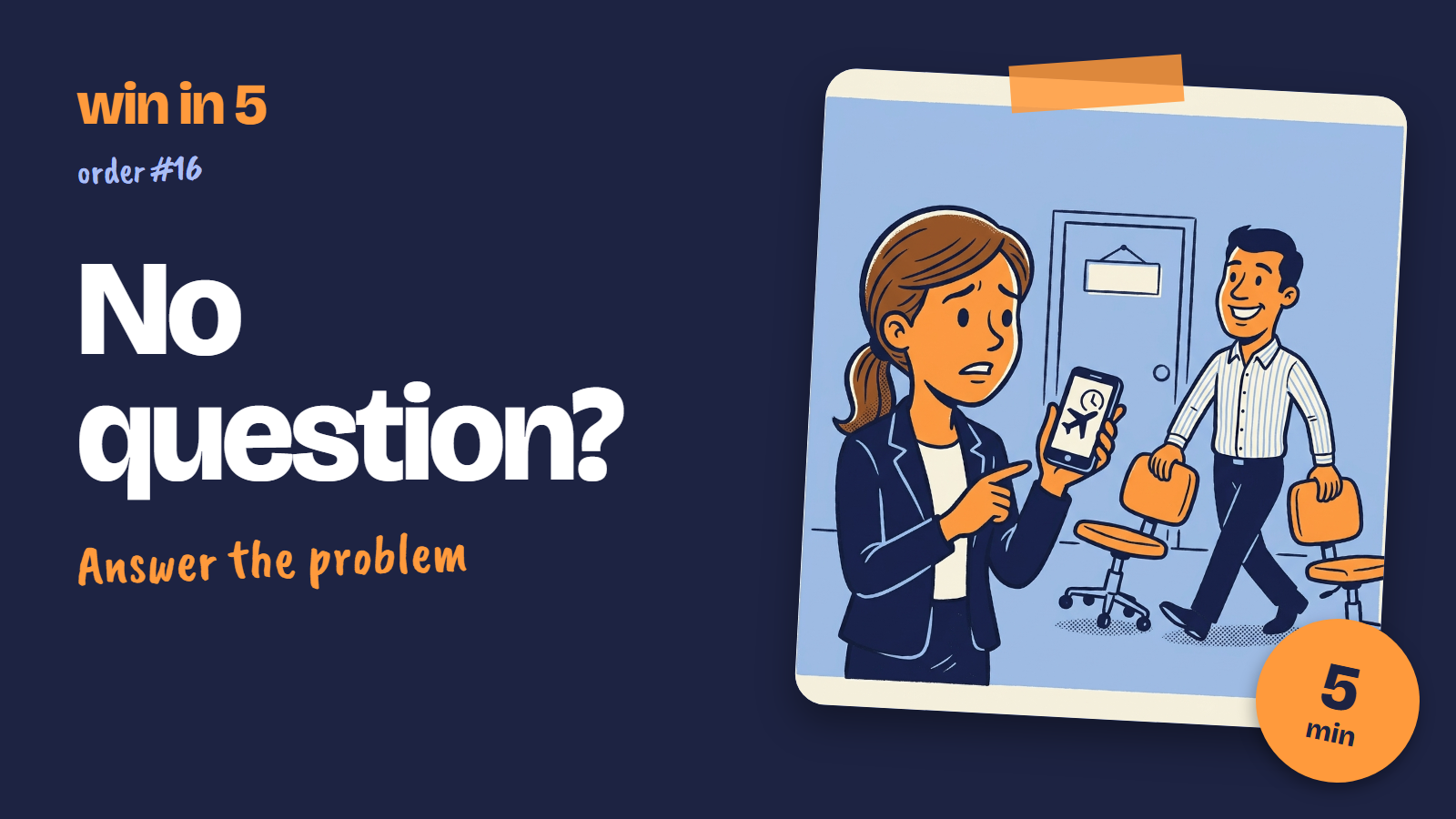
A client is on the way, and Grace has bad news for Tom. She never asks a single question, but Tom knows exactly how to reply.
Part 2 = Question–Response: hear a question, pick the best reply.
The short answer
On the TOEIC, some Part 2 lines are statements, not questions. The best reply often reacts to the problem, like an offer: “I'll bring a couple more.”
Watch out for replies that only say yes and don't help with the problem.
First, listen in
A client is visiting the office this afternoon. Grace has some last-minute news for her coworker Tom, and none of it is good.
today’s menu
Say it another way
5 phrases, in the order you hear them.
got delayed
GraceTom, the client's flight just got delayed.
It's going to be late.
The test may say
already booked
GraceRight. And the big meeting room is already booked.
Someone else has reserved it.
The test may say
On the test
AAnswer: We can use the small one on the fifth floor.
There's no question. Answer the problem.
though
GraceIt only has six chairs, though.
At the end of a sentence, it works a little like “but.” It adds a small problem.
I'll bring a couple more
TomI'll bring a couple more from our team area.
An offer. A reply that starts with “I'll” can be a good answer to a statement, if it fits.
keep my phone on
TomGreat. I'll keep my phone on.
He won't turn it off, so he won't miss the call.
watch out
When there's no question, some wrong answers act like there was one, or just agree, like “Yes, it is.” Others just repeat a word or a sound.
Cheat sheetwin in 5 · #16
1got delayedis running late / was pushed back
2already bookedis taken / isn't available
The big lesson
When you hear a statement, listen for the problem or the news, then pick the reply that responds to it.
Now, listen again
The conversation plays one more time. Tap each phrase when you hear it. 0 / 5
Order complete · nice ears
Your turn
One TOEIC-style question. Tap your answer.
“The big meeting room is already booked.”
Try it today
“I'll take care of it.”
When a coworker mentions a small problem, answer with “I'll.”
Read the full transcript
Welcome to Win in 5 Minutes English. I'm Jason. Did you notice something about that conversation? Grace never asked a single question. She just told Tom things. And Tom still knew exactly how to answer. The TOEIC does this too. In the short-response part of the test, you hear one line and pick the best reply out of three, and some of those lines aren't questions at all. That's Part 2.
Let's start with Grace's first line: "The client's flight just got delayed." Got delayed means it's going to be late. On the test, you might hear "The flight is running late," or "The flight was pushed back." Now look at Tom's reply: "Then we've got some extra time to fix the slides." He doesn't say yes or no. He reacts to the problem. That kind of reply is often the right one.
Next: "The big meeting room is already booked." Already booked means someone else has reserved it. On the test, that could be "The room is taken," or "The room isn't available." And Tom answers with a plan B: "We can use the small one on the fifth floor."
Then Grace says, "It only has six chairs, though." Though at the end of a sentence works a little like "but." It adds a small problem. And Tom answers with an offer: "I'll bring a couple more from our team area." Here's a tip: replies that start with "I'll" can be good answers to a statement, as long as they fit the problem. Someone shares a problem, and you offer to help.
And finally: "The client said they'd call when they land." Tom says, "I'll keep my phone on." Keep my phone on means he won't turn it off, so he won't miss the call.
So here's the trap. When there's no question, some wrong answers act like there was one. A reply like "Yes, it is" sounds polite, but it only agrees. It doesn't do anything about the problem. Other wrong answers just repeat a word or a sound. If you hear "The room is already booked," a reply like "I booked a flight last week" repeats the word, but it doesn't help with anything.
And here's today's big lesson: when you hear a statement, listen for the problem or the news, then pick the reply that responds to it.
Ready? Here are Grace and Tom again. This time, notice how Tom always answers the situation, not a question.
Every line from Grace was a statement, and every reply from Tom dealt with the situation. Extra time, a different room, more chairs, and a phone that stays on. Today's phrases: got delayed, already booked, though, I'll bring a couple more, and keep my phone on. Here's one to try today: the next time a coworker mentions a small problem, answer with I'll. Something like, "I'll take care of it." Today's page has a TOEIC question with no question mark in it. Can you pick the right reply? Give it a try in the link below.
Remember, five minutes a day is all you need to win at work, win the TOEIC, and win over your colleagues. And if your client's flight is late today, enjoy the extra coffee. Have a smooth day!


Comments