order #08 · Office Daily English
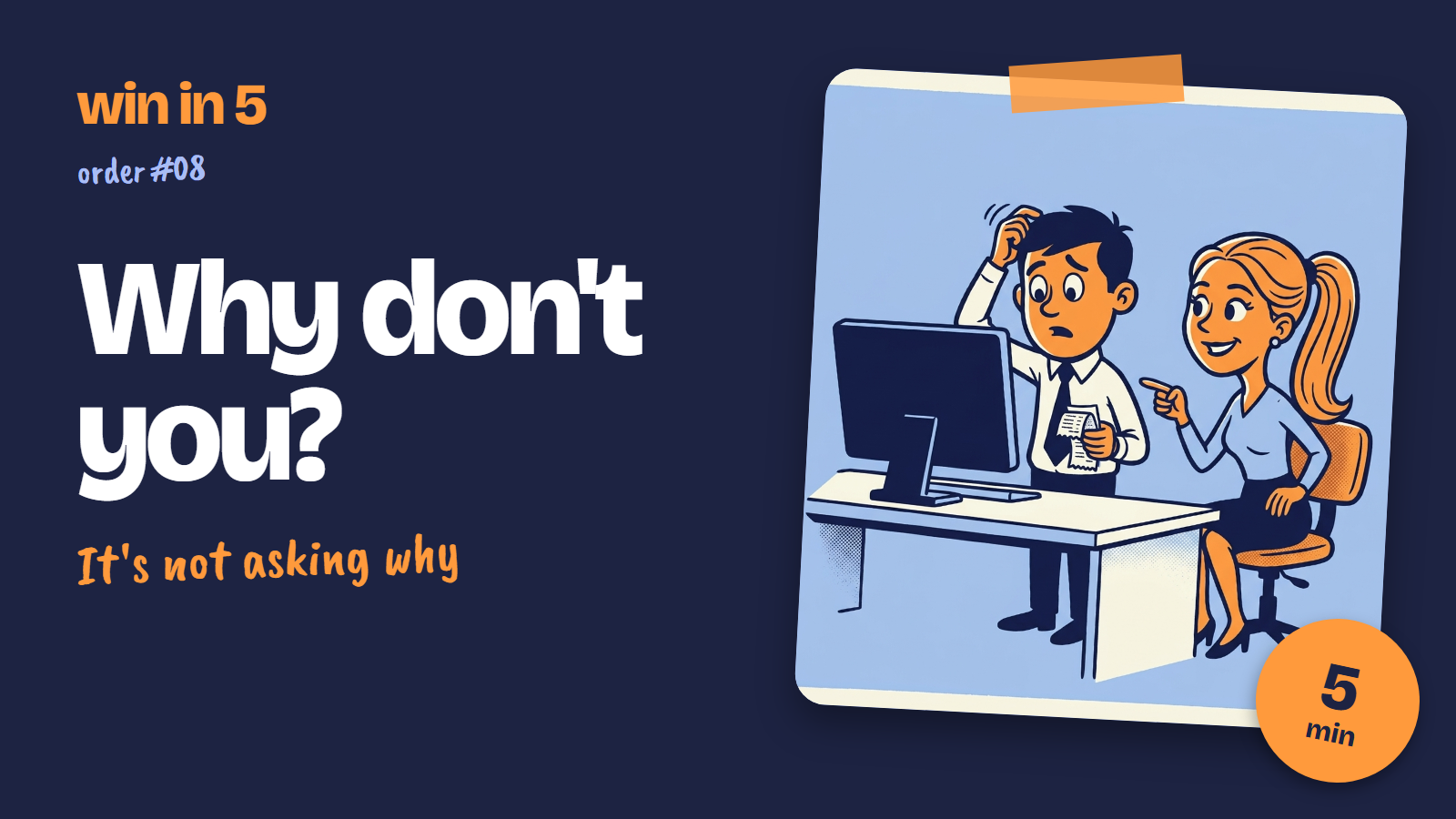
Daniel needs help with a new expense system, and Laura walks him through it. Listen to how they ask, suggest, and offer, because on the TOEIC, polite answers don't always sound the way you expect.
Part 2 = Question–Response: hear a question, pick the best reply.
The short answer
On the TOEIC, “Why don't you…?” is a suggestion, not a why question, so the right answer rarely starts with “because.”
And “Not at all” to “Would you mind…?” usually means yes, I'll help.
First, listen in
Daniel's team just switched to a new expense system, and he can't figure it out. He asks Laura, who has already used it, for some help.
today’s menu
Say it another way
5 phrases, in the order you hear them.
Not at all.
“Would you mind…?” means “Is that a problem for you?” So “Not at all” usually means yes, I'll help.
The test may say
Trap
On the test
QOn the test, question: Would you mind showing me how the new expense system works?
AAnswer: Not at all.
It sounds like no, but it's a friendly yes. “Yes, I would” usually means “Sorry, I'd rather not.”
Pull up a chair.
Come sit next to me.
Why don't you click New Report first?
Not really a why question. It's a suggestion: try this.
Trap
On the test
AAnswer: Sure, I'll do that.
The right answer usually won't start with “because.” Look for something like “Good idea.”
Sure. Let me take a look.
A polite yes to a request.
tipIn “Everything looks fine, but you missed the project code,” the important part comes right after “but.”
The test may say
Why don't I send you the link?
“Why don't I” is an offer: let me do it for you.
On the test
AAnswer: That would be great.
“Thanks, that would help” is another natural reply to an offer.
watch out
After “Why don't you,” an answer that starts with “Because” can sound right, but it answers the wrong question. Options that just repeat a word like “report” are another trap.
Cheat sheetwin in 5 · #08
1Not at all.Of course not.
4Sure. Let me take a look.I'd be happy to. / No problem.
The big lesson
With “Would you mind” and “Why don't you,” listen for the meaning, not the first word.
Now, listen again
The conversation plays one more time. Tap each phrase when you hear it. 0 / 5
Order complete · nice ears
Your turn
One TOEIC-style question. Tap your answer.
“Why don't you click New Report first?”
Try it today
“Why don't I show you?”
Use it when a coworker is stuck on something.
Read the full transcript
Welcome to Win in 5 Minutes English. I'm Jason. A new system at work, and Daniel needs help. Listen to how he asked, and how Laura answered. Asking for help, making a suggestion, offering to do something: we do this at work every day. And the TOEIC tests it too, in the part of the test where you hear a question and pick the best reply. That's Part 2. Here's the tricky part: the right answer can sound like the opposite of what you expect.
Let's start with Daniel's first line: "Would you mind showing me how the new expense system works?" "Would you mind" really means "Is that a problem for you?" So when Laura says, "Not at all," she means yes, I'll help. On the test, "Not at all" or "Of course not" can be a correct answer to a would-you-mind question. It sounds like no, but it's a friendly yes. Then she adds, "Pull up a chair." That means come sit next to me.
Next, Daniel can't find where to upload his receipts. Laura says, "Why don't you click New Report first?" Here's the one that trips people up. "Why don't you" is not really a why question. It's a suggestion. It means "Try this." So on the TOEIC, when you hear "Why don't you," the right answer usually won't start with "because." Look for something like "Good idea" or "Sure, I'll do that."
Then Daniel asks, "Could you check if I filled this out right?" That's a polite request. Laura says, "Sure. Let me take a look." In the answer choices, you might hear "I'd be happy to" or "No problem." Then she says, "Everything looks fine, but you missed the project code." Notice the "but." The important part usually comes right after it.
And then: "Why don't I send you the link?" This time it's "Why don't I." That's an offer. Laura is saying, "Let me do it for you." And Daniel answers, "That would be great." On the test, "That would be great" or "Thanks, that would help" are natural replies to an offer.
So here's the trap. After "Why don't you," an answer that starts with "Because" can sound right, but it answers the wrong question. Options that just repeat a word like "report" are another trap. And with "Would you mind," a reply like "Yes, I would" usually means "Sorry, I'd rather not."
So here's today's big lesson: with "Would you mind" and "Why don't you," listen for the meaning, not the first word.
Let's hear it again, and this time, try to catch both "why don't" lines. Neither one is asking why.
Did you catch both of them? "Why don't you click New Report first?" was a suggestion. "Why don't I send you the link?" was an offer. And "Not at all" was a yes. "Would you mind," "why don't you," "could you," "that would be great." Here's one to try today: when a coworker is stuck on something, offer to help with "Why don't I show you?" There's one TOEIC question waiting for you on today's page, right next to "Say it another way." Give it a try in the link below.
Remember, five minutes a day is all you need to win at work, win the TOEIC, and win over your colleagues. And the next time a new system shows up at work, ask the person who already gets it. They'll probably say, "Not at all." Catch you later!


Comments