order #23 · Office Daily English
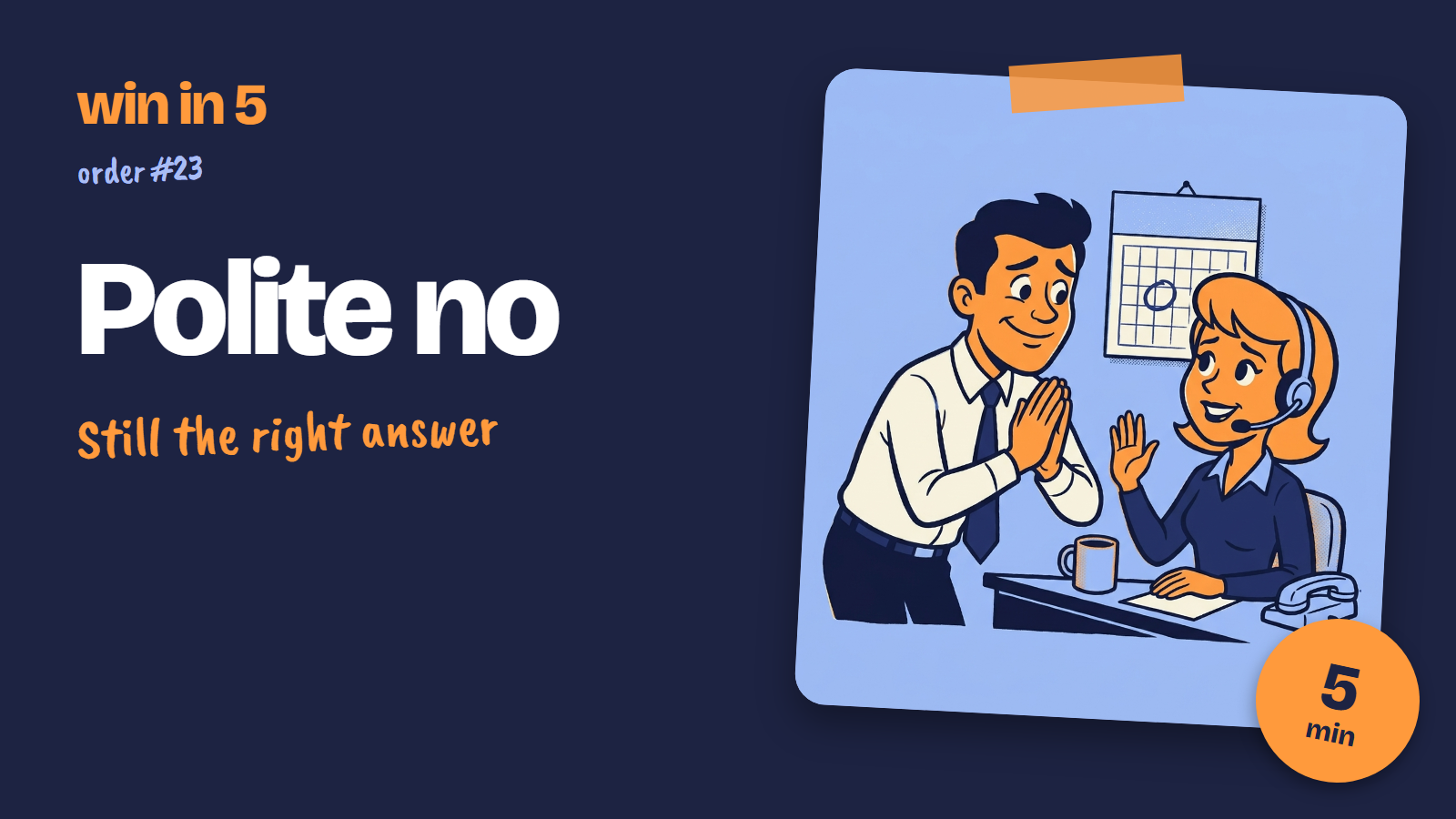
Kevin asks Emma to cover his Saturday shift, and then to take his calls on Friday. Emma says no twice, and she never says the word “no.”
Part 2 = Question–Response: hear a question, pick the best reply.
The short answer
On the TOEIC, a polite no like “I wish I could, but…” or “I'm afraid I can't” can be the best reply to a request.
Watch out for replies that just reuse a word from the question, like “cover” or “shift.”
First, listen in
It's Thursday afternoon at a customer support office. Kevin needs someone to cover his weekend shift, so he asks his teammate Emma.
today’s menu
Say it another way
6 phrases, in the order you hear them.
cover my shift
KevinHi, Emma. Could you cover my shift on Saturday morning?
A shift is your work time, like a morning shift or a night shift. “Cover my shift” means work in my place.
The test may say
Trap
I wish I could, but…
EmmaI wish I could, but I'm visiting my parents this weekend.
“I wish I could” means I'd like to help, but I can't. Then “but” gives the reason.
On the test
QOn the test, question: Could you cover my shift on Saturday morning?
AAnswer: Sorry, I have plans that weekend.
A polite no is often a correct answer, even without a yes or a no.
You could ask him.
Emma doesn't say yes or no. She tells Kevin who to ask: not the information, but the person who has it.
I'm afraid I can't.
A polite no. Here, “I'm afraid” doesn't mean scared. It just makes the no softer.
On the test
QOn the test, question: Could you take my calls on Friday afternoon?
AAnswer: Unfortunately, I'm busy then.
might be able to
EmmaActually, Lily's back on Friday. She might be able to help.
“Actually” brings in new information, and “might be able to” means maybe, not for sure.
I'll see what I can do.
I'll try, but I can't promise. A friendly way to keep the door open.
watch out
Wrong answers often reuse a word from the question with a different meaning. “Yes, the report has a new cover” starts with yes and uses “cover,” but that's the cover of a report. And “The shift starts at eight” repeats “shift,” but it doesn't answer the request.
Cheat sheetwin in 5 · #23
1cover my shiftfill in for me / take my place
The big lesson
On the TOEIC, a polite no can be the best answer. Listen for “I wish I could,” “I'm afraid,” and the word “but.”
Now, listen again
The conversation plays one more time. Tap each phrase when you hear it. 0 / 6
Order complete · nice ears
Your turn
One TOEIC-style question. Tap your answer.
“Could you cover my shift on Saturday?”
Try it today
“I wish I could, but I'm busy until four.”
The next time you have to say no at work, start a little softer.
Read the full transcript
Welcome to Win in 5 Minutes English. I'm Jason. Someone asks you to cover their Saturday shift, and you really can't. So how do you say no without sounding rude? Emma just showed us how, twice. And it's great practice for the part of the test where you hear one short question and choose the best of three replies. That's Part 2. You might remember Jessica and the meeting room from a while back. She said, "The calendar looks open after two," and that meant yes, without saying yes. Today it's the other side. On the TOEIC, the best answer can say no without ever saying no.
Let's start at the top. Kevin asks, "Could you cover my shift on Saturday morning?" A shift is your work time, like a morning shift or a night shift. Cover my shift means work in my place. On the test, you might hear fill in for me, or take my place.
Now listen to Emma: "I wish I could, but I'm visiting my parents this weekend." She never says no. But I wish I could means, I'd like to help, but I can't. Then the word but gives the reason. On the test, a reply like "Sorry, I have plans that weekend" is often a correct answer, even without a yes or a no.
Next, Kevin asks, "Do you know if Sam is free?" And Emma says, "You could ask him. He usually works weekends." She doesn't say yes or no here, either. She tells Kevin who to ask. That's another answer the test likes: not the information, but the person who has it.
Then comes a second request: "Could you take my calls on Friday afternoon?" Take my calls means answer the phone for me. And Emma says, "I'm afraid I can't. I'm in training all afternoon." I'm afraid I can't is a polite no. Here, I'm afraid doesn't mean scared. It just makes the no softer. The test might say, "Unfortunately, I'm busy then."
After that, Emma says, "Actually, Lily's back on Friday. She might be able to help." The word actually brings in new information, and might be able to means maybe, not for sure.
And finally: "If nobody can do Saturday, let me know. I'll see what I can do." I'll see what I can do means, I'll try, but I can't promise. It's a friendly way to keep the door open.
Now, the trap. Wrong answers often reuse a word from the question with a different meaning. "Yes, the report has a new cover" starts with yes and uses the word cover, but that's the cover of a report, not a shift. And "The shift starts at eight" repeats shift, but it doesn't answer the request.
So here's today's big lesson: on the TOEIC, a polite no can be the best answer. Listen for I wish I could, I'm afraid, and the word but.
Ready for round two? Here's the conversation again. Pay attention to how Emma says no, without ever saying the word no.
Two requests, two polite answers, and not a single no. Did you catch how she did it? Today's phrases: cover my shift, I wish I could, you could ask him, I'm afraid I can't, and I'll see what I can do. Here's one to try today: the next time you have to say no at work, start a little softer. Something like, "I wish I could, but I'm busy until four." On today's page, there's one quick TOEIC question, and "Say it another way" shows how the test might say a polite no. You'll find it in the link below.
Remember, five minutes a day is all you need to win at work, win the TOEIC, and win over your colleagues. And if someone asks you to cover a shift this week, now you know how to say no nicely. Unless you really want that Saturday morning. Have a good one!


Comments