order #20 · Office Daily English
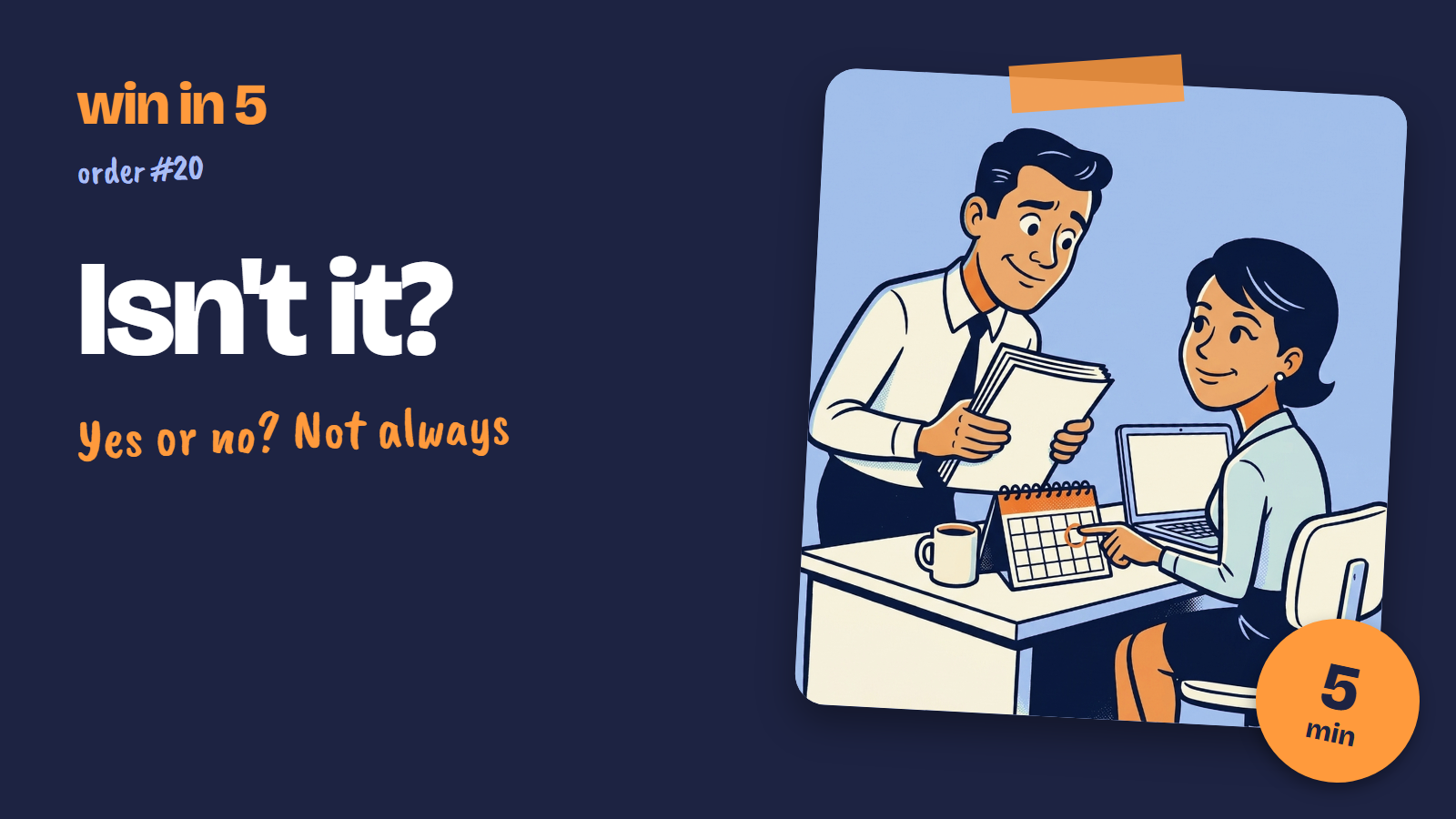
Mark wants to check a deadline, so he ends his sentences with “isn't it?” and “haven't you?” Lisa mostly skips a simple yes or no and just gives the facts.
Part 2 = Question–Response: hear a question, pick the best reply.
The short answer
On the TOEIC, a tag question like “…, isn't it?” is a check, and the best reply often skips yes or no and just gives the real information.
A reply that starts with “actually” is often a strong answer.
First, listen in
Mark and Lisa are working on a sales report together. Mark thinks it's due today, so he checks with Lisa before he plans to stay late.
today’s menu
Say it another way
6 phrases, in the order you hear them.
isn't it?
A tag question. It means “I think this is true. Can you confirm?” “Due today” means it has to be finished today.
Trap
On the test
AAnswer: Actually, Ms. Chen gave us until Friday.
A reply that starts with “actually” is often a strong answer.
gave us until Friday
LisaActually, Ms. Chen gave us until Friday.
They have more time. The deadline is now Friday.
The test may say
Just the first page.
No yes or no, but you know the answer: she started, but only a little.
Normally, yes.
“Normally” means that's what usually happens, but maybe not this week. “Give them a call” just means call them.
That's the plan.
A natural way to say yes: that's what we've agreed to do. “Take care of” means handle, or be in charge of.
The test may say
I'll have them ready by Thursday
MarkSure. I'll have them ready by Thursday.
They'll be finished by Thursday.
watch out
Wrong answers can start with “yes,” then say something that doesn't fit, like “Yes, it's due on Friday.” Watch out for repeated words, too, like “The weather report says rain.”
Cheat sheetwin in 5 · #20
2gave us until FridayIt's been moved to Friday.
5That's the plan.As far as I know. / I believe so.
The big lesson
A tag question is a check, and the best reply often just gives the real information.
Now, listen again
The conversation plays one more time. Tap each phrase when you hear it. 0 / 6
Order complete · nice ears
Your turn
One TOEIC-style question. Tap your answer.
“The sales report is due today, isn't it?”
Try it today
“The meeting's at two, isn't it?”
The next time you want to double-check something at work, add a tag at the end.
Read the full transcript
Welcome to Win in 5 Minutes English. I'm Jason. Deadlines move all the time. So before you stay late to finish something, it's smart to check. That's what Mark just did, and he used a little trick at the end of his sentences. Isn't it? Haven't you? Don't they? These are called tag questions. On the TOEIC, they show up in the part of the test where you hear one short question or comment and choose the best of three replies. That's Part 2. And here's the surprise: the best reply often doesn't start with yes or no.
Let's go back to the start. Mark says, "The sales report is due today, isn't it?" Due today means it has to be finished today. And the little tag at the end, isn't it, means: I think this is true, can you confirm? So it's not really an open question. It's a check.
Now listen to Lisa: "Actually, Ms. Chen gave us until Friday." She doesn't say yes. She doesn't say no. She just gives the real information. And the word actually is a big signal. It often means, what you think isn't quite right. On the test, a reply that starts with actually is often a strong answer. Gave us until Friday means they have more time. The deadline is now Friday. The test could say, "It's been moved to Friday."
Next, Mark asks, "You've already started on it, haven't you?" Lisa says, "Just the first page." Again, she doesn't say yes or no. But you know the answer: she started, but only a little.
Then, "They usually send those on Mondays, don't they?" Lisa says, "Normally, yes." This time there is a yes, but notice the word normally. It means that's what usually happens, but maybe not this week. And she adds, "I'll give them a call this afternoon." Give them a call just means call them.
After that, "We're presenting it together, aren't we?" Lisa says, "That's the plan." That's a natural way to say yes. It means that's what we've agreed to do. On the test, you might hear "As far as I know," or "I believe so."
Finally, Lisa asks, "Can you take care of the charts?" Take care of means handle, or be in charge of. And Mark says, "I'll have them ready by Thursday." That means they'll be finished by Thursday.
Now, the trap. Wrong answers can start with yes, then say something that doesn't fit. "Yes, it's due on Friday" sounds polite, but yes here would mean it's due today, and then it says Friday. That doesn't make sense. And watch out for repeated words. "The weather report says rain" uses report, but it has nothing to do with the deadline.
So here's today's big lesson: a tag question is a check, and the best reply often just gives the real information.
One more listen. Focus on how Lisa answers each tag. Does she say yes or no, or does she just tell Mark the facts?
So, how many times did you hear the word yes? Just once, and even then, Lisa added normally. Today's phrases: isn't it, gave us until Friday, just the first page, that's the plan, and I'll have them ready by Thursday. Here's one to try today: the next time you want to double-check something at work, add a tag at the end. Something like, "The meeting's at two, isn't it?" Ready to test yourself? There's one quick TOEIC question waiting for you on today's page, in the link below.
Remember, five minutes a day is all you need to win at work, win the TOEIC, and win over your colleagues. And if someone double-checks something with you today, try giving them the facts instead of just a yes or no. Take it easy!


Comments