order #05 · Office Daily English
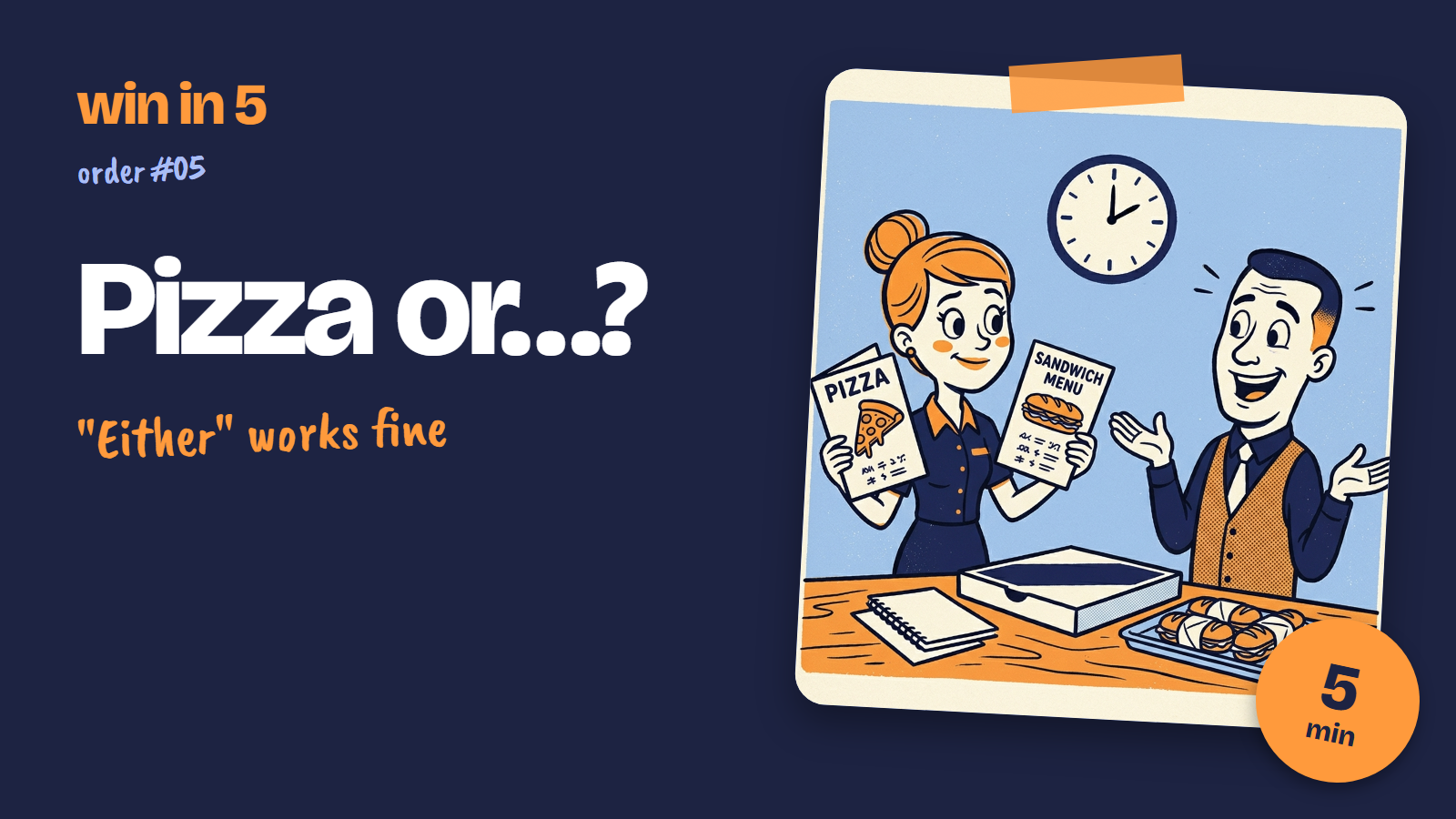
Emily is ordering lunch for a training session, and almost every question she asks has two choices. Kevin's answers mostly pick neither one, and they still work.
Part 2 = Question–Response: hear a question, pick the best reply.
The short answer
The right answer to an “or” question doesn't always pick A or B.
On the TOEIC, “Either is fine,” a third choice, or “I'd check the sign-up sheet” can be correct.
First, listen in
Emily is ordering lunch for a team training session. Before she places the order, she checks a few things with her manager, Kevin.
today’s menu
Say it another way
6 phrases, in the order you hear them.
Either is fine with me.
One or the other. It doesn't matter which.
The test may say
On the test
QOn the test, question: Should I get pizza or sandwiches?
AAnswer: Either is fine with me.
All three can be correct answers to an “or” question.
Whichever is easier for you.
A polite way to let the other person decide.
tipAt work, it sounds friendly and flexible, and it saves everyone time.
Let's say one o'clock.
Not noon, not twelve thirty. A new time.
On the test
QOn the test, question: Do you want it delivered at noon or at twelve thirty?
AAnswer: Let's say one o'clock.
The right answer can be a third choice that neither option mentioned.
put it on the company card
EmilyGot it. And should I put it on the company card or my own?
Pay with the company's card.
The test may say
I'd check the sign-up sheet.
He doesn't give a number. He tells her where to find the answer.
On the test
QOn the test, question: Do you think fifteen people will come, or will it be more?
AAnswer: I'd check the sign-up sheet.
Replies like this can be correct answers in Part 2.
just in case
EmilyGood idea. I'll order a few extra just in case.
To be safe, in case something happens.
The test may say
watch out
An “or” question usually isn't answered with a plain “yes” or “no.” If an option starts with “Yes,” be careful. It's often a trap.
Cheat sheetwin in 5 · #05
1Either is fine with me.I don't mind. / Whichever you prefer.
4put it on the company cardcharge it to the company / use a corporate card
6just in caseas a precaution / to be safe
The big lesson
When you hear "or," don't wait for A or B. Listen for the answer that makes sense.
Now, listen again
The conversation plays one more time. Tap each phrase when you hear it. 0 / 6
Order complete · nice ears
Your turn
One TOEIC-style question. Tap your answer.
“Should I get pizza or sandwiches?”
Try it today
“Either is fine with me.”
Use it when someone gives you two choices and you really don't mind.
Read the full transcript
Welcome to Win in 5 Minutes English. I'm Jason. Ordering lunch for the team sounds easy, until you have to decide everything. We just heard Emily ask Kevin four questions, and every one had two choices: this or that. But here's the interesting part. Kevin picked one of the two choices only once, and every answer still made sense. That matters on the TOEIC, because in Part 2, the correct answer to an "or" question doesn't always choose one of the two choices.
Let's start with the first question: "Should I get pizza or sandwiches?" Kevin says, "Either is fine with me." Either means one or the other, and it doesn't matter which. On the test, you might hear the same idea as "I don't mind" or "Whichever you prefer." All three can be correct answers to an "or" question.
Then he adds, "Whichever is easier for you." This is a polite way to let the other person decide. At work, it sounds friendly and flexible, and it saves everyone time.
Next: "Do you want it delivered at noon or at twelve thirty?" Kevin says, "Actually, the session might run late. Let's say one o'clock." Not noon. Not twelve thirty. A brand-new time. On the TOEIC, the right answer can be a third choice that neither option mentioned.
Now the payment: "Should I put it on the company card or my own?" "Use the company card." Here Kevin does pick one, and that's fine too. To put something on a card means to pay with it. In the answer choices, it might become "charge it to the company" or "use a corporate card."
Then Emily asks, "Do you think fifteen people will come, or will it be more?" And Kevin says, "I'd check the sign-up sheet." He doesn't give a number. He tells her where to find the answer. Replies like that can be correct answers in Part 2.
And last: "I'll order a few extra just in case." Just in case means to be safe, in case something happens. On the test, it could be "as a precaution" or "to be safe."
So here's the trap. An "or" question usually isn't answered with a plain "yes" or "no." So if an option starts with "Yes," be careful. It's often a trap. Listen for the answer that makes sense, not just for one of the two choices.
Let's hear it again, and this time, try to catch every answer that doesn't simply pick one of the two choices.
That second listen is where it clicks, right? Either is fine with me. Let's say one o'clock. I'd check the sign-up sheet. Three answers, and none of them simply picked one of the two choices. Here's one to try today: when someone gives you two choices and you really don't mind, say, "Either is fine with me." Want to see how the test could say today's phrases? Check "Say it another way" in the link below.
Remember, five minutes a day is all you need to win at work, win the TOEIC, and win over your colleagues. Enjoy your lunch today, pizza or sandwiches. Take care!


Comments